Guppies give birth to live, free-swimming baby fish rather than laying eggs. A pregnant female guppy carries developing young inside her body, then releases fully formed fry one at a time, often over several hours. Knowing the guppy birthing process helps you protect the mother, prepare a safe space, and give newborn guppy fry the best chance to survive.
Guppies are livebearers, which means they give birth to live young. This makes guppy fish reproduction different from many freshwater fish species that scatter eggs or guard a nest. If you keep male and female guppies together, breeding can happen quickly, so preparation matters.
How Do Guppies Give Birth?
Guppies give birth to live young. A female guppy does not lay eggs in the aquarium; instead, she carries fertilized eggs inside her body until the babies develop enough to swim and feed on their own.
During the guppy birthing process, the mother releases tiny fry, usually tail-first or curled into a small ball. Healthy newborn guppies quickly uncurl, swim upward, and begin searching for food. Stillborn or weak fry may sink and remain motionless. lovetoknow
Guppies are livebearers, so the babies are called fry rather than eggs. A guppy can give birth without a male present if she stored sperm from an earlier mating, which is why an apparently single female may still produce a brood.
What “livebearer” means
A livebearer is a fish that gives birth to live, free-swimming young instead of laying eggs. Guppies, mollies, platies, and swordtails are common livebearers in home aquariums.
What Are the Signs That a Guppy Is About to Give Birth?
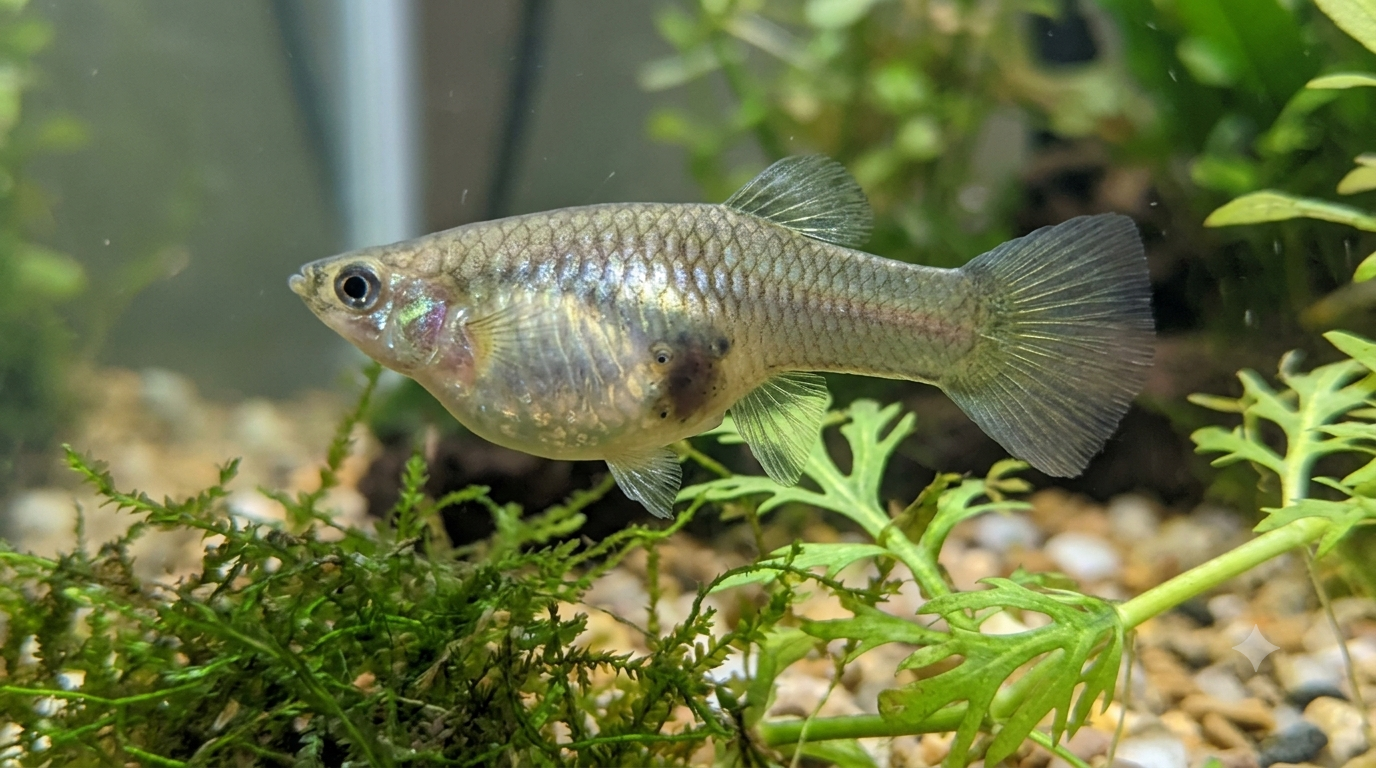
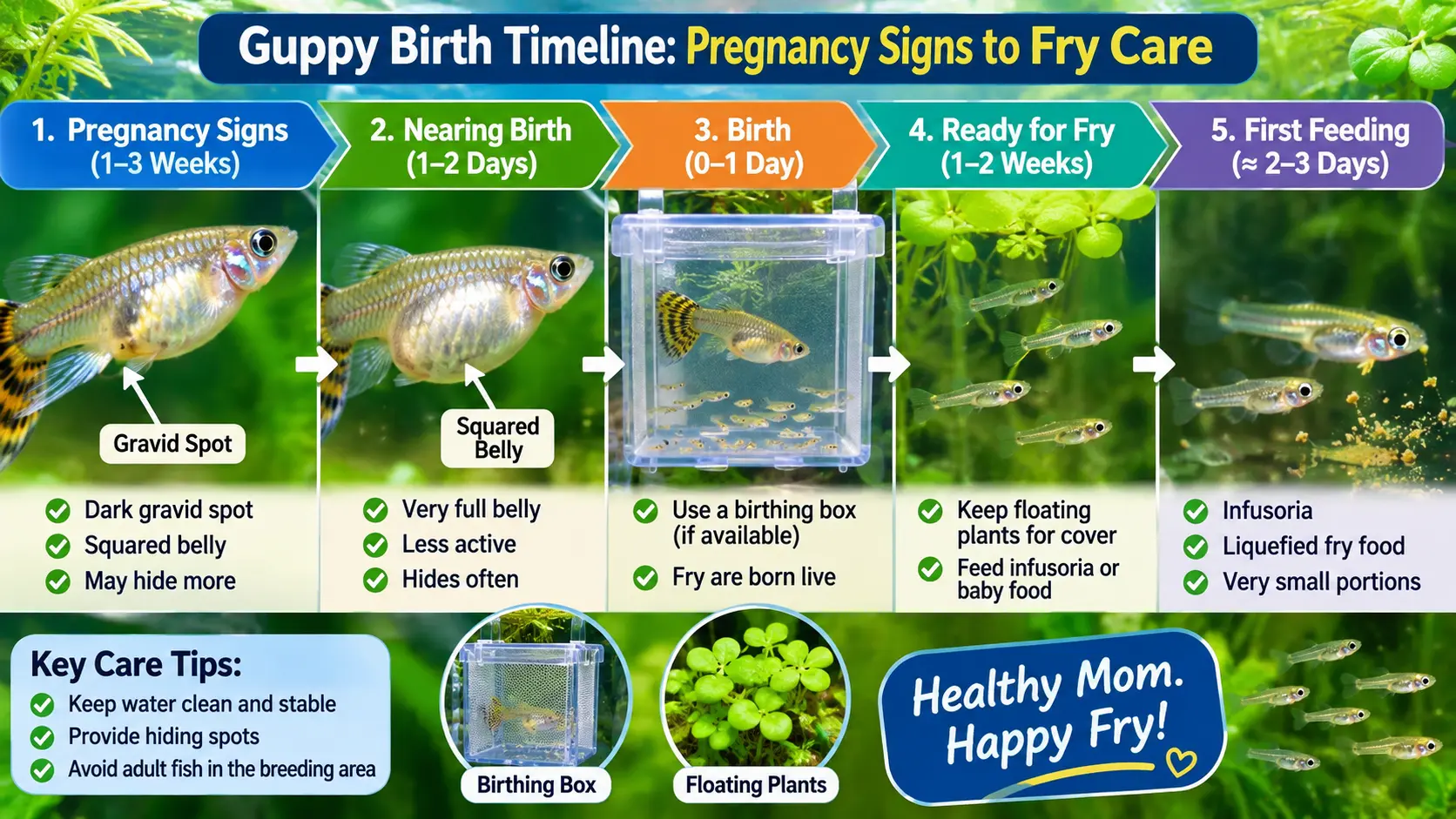
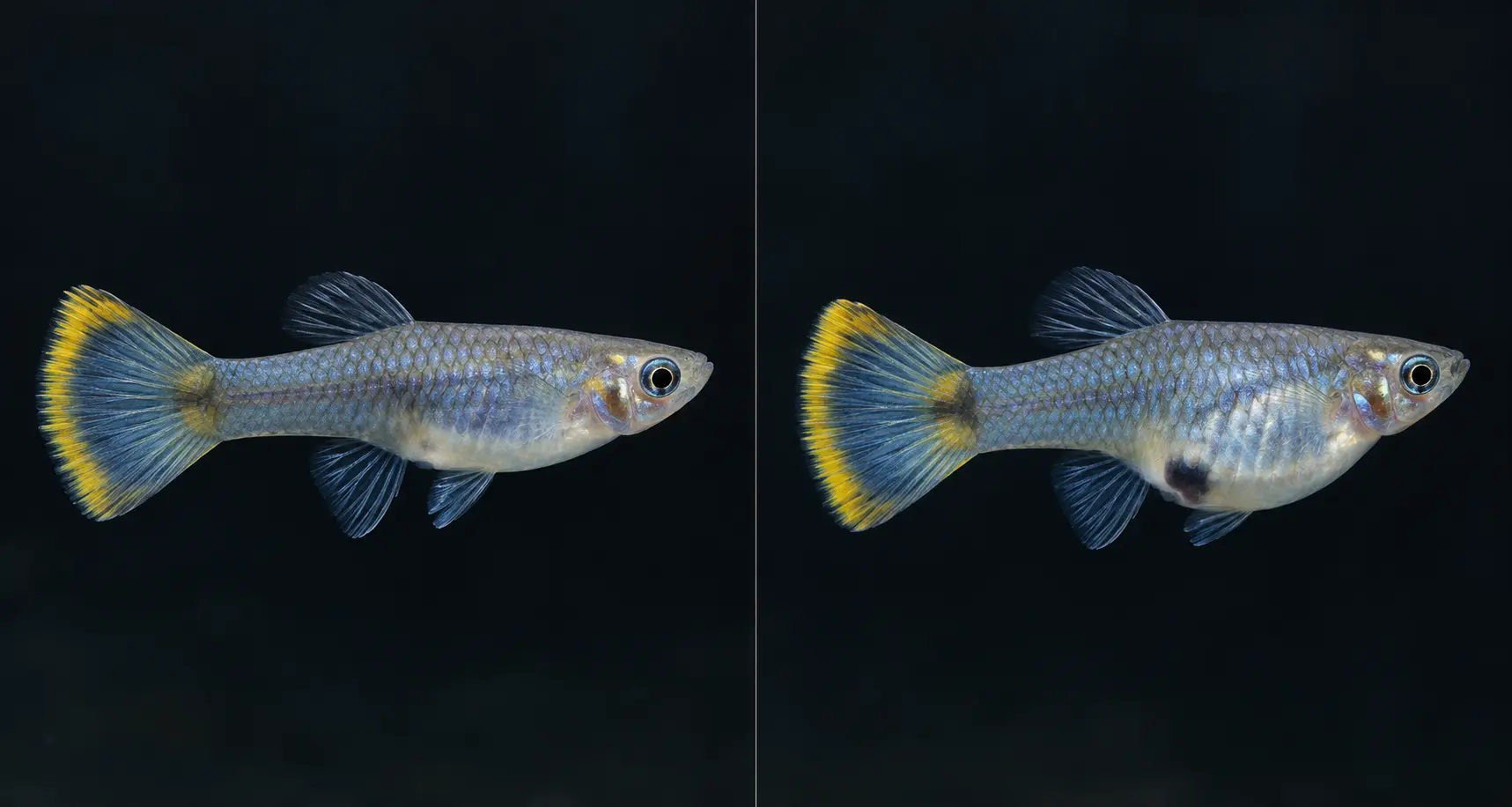
The most reliable guppy giving birth signs appear near the end of pregnancy. Look for a very dark gravid spot, a boxy belly, hiding behavior, and less interest in food. These signs of a pregnant guppy do not guarantee birth will happen that day, but they usually mean the female is close.
Guppy labor signs to watch
- Dark gravid spot: The spot near the anus, just in front of the tail, becomes larger and darker as fry develop. In albino or pale-colored guppies, it may look pink, orange, or brown rather than black.
- Squared-off belly: A pregnant guppy’s rounded abdomen can look box-shaped when she is close to giving birth.
- Hiding: She may rest behind plants, decorations, or filter equipment instead of swimming openly.
- Reduced appetite: Some females refuse food or spit it out shortly before labor.
- Restlessness or shivering: Quick body movements, tail lifting, or shuddering can occur during contractions.
- Avoiding males: A pregnant female may chase away persistent males as birth approaches.
Late pregnancy or active labor?
Late pregnancy usually develops over several days. Active guppy labor signs include repeated contractions, staying in one sheltered area, and releasing one or more fry. If you see tiny fish swimming away from her, she is already giving birth.
How Long Does It Take for Guppies to Give Birth?
There is no exact labor duration that applies to every guppy. Many females release a batch of fry over roughly 4 to 6 hours, while stress, a large brood, or an unsettled aquarium can extend the process to 12 hours or longer.
Some guppy moms give birth in waves. They may release several fry, pause, then deliver more later. A female may also deliver a small number of fry over more than one day, although long gaps can sometimes mean the birth was interrupted or that some young were not viable.
Avoid repeatedly netting, chasing, or moving a laboring female. Stress can interrupt the guppy birthing process and make recovery harder for the mother.
How Many Babies Do Guppies Give Birth To at Once?
A female guppy can give birth to anywhere from 2 to 200 babies in one brood, but most home aquarium births are much smaller. A common range is about 20 to 60 fry, while younger or smaller females may produce fewer.
The number of many fry depends on the female’s age, size, health, genetics, nutrition, and aquarium conditions. A well-fed, mature female usually produces more babies than a young female having her first guppy birth. bettaaquatic
| Factor | Effect on fry number |
|---|---|
| Age and size | Larger, mature females often carry more fry. |
| Health and nutrition | A well-fed female is more likely to support a healthy brood. |
| Stress and water quality | Poor conditions can reduce fry survival and disrupt birth. |
| Genetics | Some lines naturally produce larger or smaller batches. |
What Does a Guppy Giving Birth Look Like?
A guppy fish giving birth often looks calmer than you might expect. The female may hover near plants, breathe faster, make small shivering movements, and release fry one by one.
Newborn guppy fry are extremely small, usually only a few millimeters long. They are fully formed and free-swimming young, but they may initially look like tiny curled specks before they straighten and swim.
Healthy new fry generally swim upward and actively look for food. Fry that sink, lie on the substrate, or fail to swim may be premature, weak, or stillborn. Remove dead fry promptly so they do not affect water quality.
Where Do Guppies Prefer to Give Birth in an Aquarium?
Pregnant guppies often seek quiet, sheltered areas before giving birth. Dense plants, floating plants, caves, and shaded corners give the mother a sense of security and give newborn fry places to hide.
A planted aquarium with hiding spots like java moss, guppy grass, water sprite, or floating plants can improve fry survival. These areas create barriers between baby guppies and adult fish.
Create a safe birthing environment
- Keep the water temperature stable and appropriate for guppies.
- Avoid sudden water changes, loud activity, or overcrowding.
- Provide dense plants and floating cover.
- Use a gentle sponge filter rather than a powerful filter intake.
- Keep aggressive tank mates away from the birthing area.
What Should You Do When Your Guppy Gives Birth?
If your guppy gives birth in a community aquarium, protect the fry immediately. Adult guppies, including the mother guppy, may eat newborn fish, so separation or dense cover is important.
You can use a breeder box, a mesh breeding net, or a separate fry tank. A breeder box hangs inside the main aquarium and allows water to circulate while keeping fry safe from adult fish.
Birth-day checklist
- Do not chase the mother. Let her deliver naturally.
- Protect the fry. Move fry to a breeder box or nursery tank, or add dense plants.
- Give the mother quiet time. Let her recover for several hours before returning her to the main aquarium.
- Feed tiny foods. Offer food sized for newborn fry once they are actively swimming.
- Check filtration. Cover or replace strong intakes with a sponge filter so fry cannot be pulled in.
- Remove dead fry. This keeps the birthing tank cleaner and reduces waste.
Do Guppies Eat Their Babies After Giving Birth?
Yes. Adult guppies can eat their babies, and the mother guppy may eat her own fry soon after birth. This is normal livebearer behavior, not a sign that she is a “bad parent.”
To keep fry safe, use one of these methods:
- Breeder box: Keeps the mother and fry separated while maintaining water flow.
- Separate tank: Best for raising a larger group of fry.
- Dense plants: Offers hiding spots, although it does not guarantee every fry will survive.
- Floating plants: Create surface cover where small fry can shelter.
Remove the mother from a breeder box once she has finished giving birth. Leaving her there too long can stress her and increase the chance that she eats fry.
How to Care for Baby Guppies After Birth
Newborn guppy fry care starts with tiny food, clean water, and gentle filtration. Fry can begin eating soon after birth, so offer powdered fry food, crushed flakes, infusoria, or newly hatched baby brine shrimp in very small amounts.
Feed small portions several times a day rather than one large meal. Uneaten food can quickly pollute a small fry tank, so remove leftovers and perform small, frequent water changes.
Fry care essentials
- Food: Start with fry-sized food; baby brine shrimp and finely crushed flakes work well.
- Filtration: Use a sponge filter to prevent fry from being drawn into the filter.
- Water quality: Keep the aquarium clean and stable; avoid large, sudden water changes.
- Light: Provide about 8 to 12 hours of light daily to support healthy growth.
- Space: Move fry to the main aquarium only when they are too large for adult fish to eat, often around half an inch long.
How Soon Can Guppies Give Birth Again?
Female guppies can reproduce quickly. Under good conditions, a female may give birth about once a month because the gestation period for guppies is commonly around 21 to 30 days.
Guppies can store sperm after mating, so a female can produce several broods even after she is separated from males. This is why fish breeding can get out of control fast in a community aquarium.
For responsible breeding, keep more females than males, avoid overcrowding, and have a plan for the fry. A single female can produce many babies over time, and repeated pregnancies can place demands on her health and your aquarium space.
FAQs
How long does it take for guppies to give birth?
Many guppies give birth over 4 to 6 hours, but the process can take 12 hours or longer if the female is stressed or delivering a large brood. Some females deliver in batches with pauses between groups of fry.
How many babies do guppies have?
A guppy can give birth to 2 to 200 fry, although many aquarium births produce a smaller batch. The exact number depends on the female’s age, size, health, and living conditions.
Do guppies give live birth?
Yes. Guppies are livebearers and give birth to live, free-swimming fry rather than laying eggs.
How many fry can a guppy have?
A single guppy may have from a few fry to more than 100, with 2 to 200 possible in exceptional cases. Do not expect every female to produce a huge brood.
How many guppy fry are born at once?
Fry are usually released one at a time, but they may appear in quick succession. A batch can include dozens of babies, depending on the mother.
How many babies do guppies have in a year?
A healthy female may have a brood roughly every month, so she could produce several batches in a year. The total number varies widely with care, age, genetics, and aquarium conditions.
How often can guppies have babies?
Female guppies can become pregnant again soon after giving birth, often about once a month under optimal conditions.
How many days does guppy give birth?
Gestation commonly lasts 21 to 30 days, with 22 to 26 days often cited as an average. Water temperature, cleanliness, stress, and the female’s health can change the timing.
How often do guppies give birth?
Many female guppies give birth approximately every 30 days when conditions are stable and they have access to males or stored sperm.
How long does it take to breed guppies?
Guppies can breed quickly once males and females share an aquarium. After mating, allow roughly 21 to 30 days for pregnancy, then prepare protection for the fry.
Do guppies lay eggs?
No. Guppies do not normally lay eggs. They give birth to live young, although a female may occasionally expel unfertilized or undeveloped eggs.
Do guppies breed a lot?
Yes. Guppies can reproduce frequently, especially in a warm, well-fed aquarium with both sexes present. Plan for fry before adding males and females together.
Conclusion
Understanding how do guppies giving birth work helps you protect both the pregnant mother and her newborn fry. Guppies give birth to live, free-swimming babies rather than laying eggs, and a female may deliver a brood over several hours or in smaller batches. Watch for a dark gravid spot, a squared belly, hiding behavior, and reduced appetite as birth approaches.
Prepare a calm aquarium with plants, gentle filtration, and a breeder box or separate nursery. Feed the mother well, avoid unnecessary handling, and remove adult fish from the fry area once birth is complete. With stable water, tiny frequent meals, and safe hiding spots, baby guppies can grow quickly and thrive. Responsible guppy fish reproduction means planning ahead: separate sexes when needed, avoid overcrowding, and give every new guppy the care it needs for a successful guppy breeding.
You might also like
- Is My Female Guppy Fat or Pregnant: Don’t Miss These Warning Signs!
- Do Guppies Need Air Bubbles: (3 Easy Ways to Fix Oxygen)
- What Do Guppy Fish Eggs Look Like: 3 Important Facts!
- How Long Does It Take for a Guppy fish giving Birth?
- What Do Baby Guppy Fry Eat: 5 Nutritional Foods for Rapid Growth!
- Male vs Female Guppies: 5 Proven Ways to Spot the Gender!
- Do Guppies Die After Giving Birth? (5 Causes & Solutions)
- Do Guppies Sleep At Night: The Truth about Guppies Sleeping!
- Best Guppies Breeding Temperature Success!
- Pregnant Guppy Not Giving Birth: 3 Causes & Quick Help!
- When Do Guppies Get Their Color: (The Shocking Truth)