Choosing the perfect fish tank size for goldfish is essential if you want healthy, active fish that thrive for years. For a single fancy goldfish, a 20-gallon tank serves as a reasonable starting point, while common and comet goldfish need at least 55 gallons, preferably a larger tank or pond as they grow.
Each additional goldfish requires more swimming space and stronger filtration. This guide covers tank size recommendations, stocking levels, filtration, and the differences between fancy and single-tail goldfish.
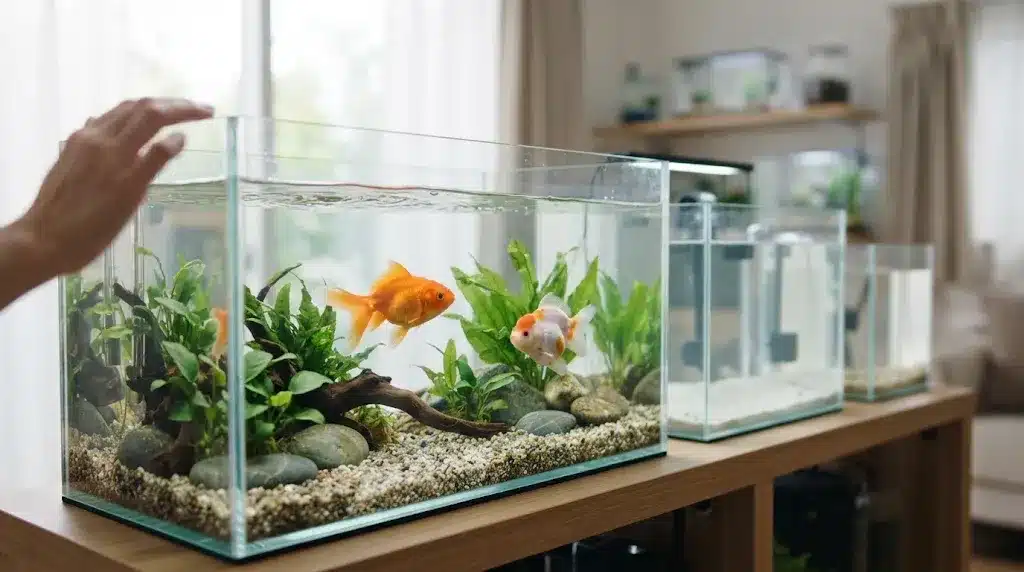
The perfect Goldfish tank size depends on the variety and the number of fish you plan to keep. As a starting point, one fancy goldfish needs at least a 30-gallon tank, while common, comet, and shubunkin goldfish need a much larger aquarium or pond because they grow larger and swim faster.
Many people buy a small tank because goldfish are sold as tiny, inexpensive pets. The problem is that a young goldfish will not stay small. With good goldfish care, it can grow into a large, active adult fish that needs clean water, strong filtration, and room to swim.
Choosing the right tank size from the beginning protects fish welfare and prevents stressful upgrades later.
What Is the Best Tank Size for Goldfish?
The best fish tank size for goldfish is not one number for every fish. Fancy goldfish and single-tail goldfish have different adult sizes, swimming styles, and waste production.
For a beginner, a 40-gallon breeder-style aquarium is a strong starting choice for two fancy goldfish. It provides more stable water conditions than a smaller tank and gives the fish a wide swimming area. A 30 gallon tank can work for one adult fancy goldfish, but it leaves little room for error, décor, and future additions.
Common goldfish, comet goldfish, and shubunkins are different. These fish are streamlined, fast, and can reach a large size. They need a long aquarium with a big footprint or, ideally, a properly filtered outdoor pond. A 75-gallon tank is a more realistic minimum for a small group, and even that can become crowded as the fish mature.
| Goldfish type | Adult size | Goldfish Minimum tank size | Better long-term choice |
|---|---|---|---|
| Fancy goldfish | About 6–8 inches | 30 gallons for one | 40–55 gallons for two |
| Common goldfish | 10–12 inches or more | 55–75 gallons for one or two | Pond or very large aquarium |
| Comet goldfish | 10–14 inches or more | 75 gallons for one or two | Pond or very large aquarium |
| Shubunkin | 10–12 inches or more | 75 gallons for one or two | Pond or very large aquarium |
These are minimums, not targets. A larger tank is almost always better because it dilutes waste, supports stable water quality, and gives goldfish more space to behave naturally. The RSPCA notes that larger aquariums have more stable temperatures and water conditions, and that overcrowding can pollute water and reduce oxygen. rspca.org
How Many Gallons Does One Goldfish Need?
A useful rule is to plan for the adult size of the fish, not the size it is when you bring it home. A juvenile goldfish may look tiny in a 10-gallon tank, but it will quickly outgrow that space.
For one fancy goldfish, start with at least a 30-gallon tank. A 40-gallon tank is better because it offers more swimming room and makes maintenance easier. Fancy varieties include fantails, orandas, ranchus, and black moors. They usually stay smaller than single-tail goldfish, but their rounded bodies and long fins still need space to turn comfortably.
For one common goldfish, plan on a 55- to 75-gallon tank at minimum. These fish can grow to 10 inches or longer and produce a heavy bioload. A pond is often the best home because it provides the length, volume, and filtration that a large adult fish needs.
Avoid relying on the old “one inch of fish per gallon” rule. It does not work well for goldfish because they produce far more waste than many tropical fish. Instead, consider the adult fish size, tank dimensions, filtration capacity, feeding routine, and water-change schedule.
Fancy vs. Common Goldfish: How Tank Size Differs
Goldfish are not all the same. The biggest mistake new fish keepers make is treating a fancy goldfish and a comet goldfish as if they need identical housing.
Tank Size Requirements for Fancy Goldfish
Fancy goldfish have round bodies, double tails, and often large fins or head growth. They tend to swim more slowly than single-tail varieties, but they still need a wide tank with room to turn.
- One fancy goldfish: 30-gallon minimum; 40 gallons is better.
- Two goldfish: 40- to 55-gallon tank.
- Three fancy goldfish: 55- to 75-gallon tank.
- Four or more fancy goldfish: 75 gallons or larger, depending on filtration and adult size.
A 30-gallon tank is an absolute minimum tank size for one adult fancy goldfish. It is not a good long-term home for several fish. Fancy goldfish are social, so keeping only one fish can leave it without normal company. INJAF notes that goldfish benefit from companions and should not be kept alone. injaf
Tank Size Requirements for Common and Comet Goldfish
Common, comet, and shubunkin goldfish have slim bodies and single tails. They are strong swimmers and can move quickly across a tank. They also tend to grow larger than fancy varieties.
- One common or comet goldfish: 55- to 75-gallon minimum.
- Two common or comet goldfish: 75- to 100-gallon tank.
- A small group: 125 gallons or more, or a pond.
- Best option: A large, well-filtered outdoor pond.
A 20-gallon tank may temporarily hold very young fish, but it is not a suitable permanent home. Goldfish grow quickly when they receive proper food, clean water, and enough space. INJAF recommends at least 120 cm x 50 cm x 50 cm for fancy varieties and at least 200 cm x 60 cm x 60 cm for common or single-tail goldfish.
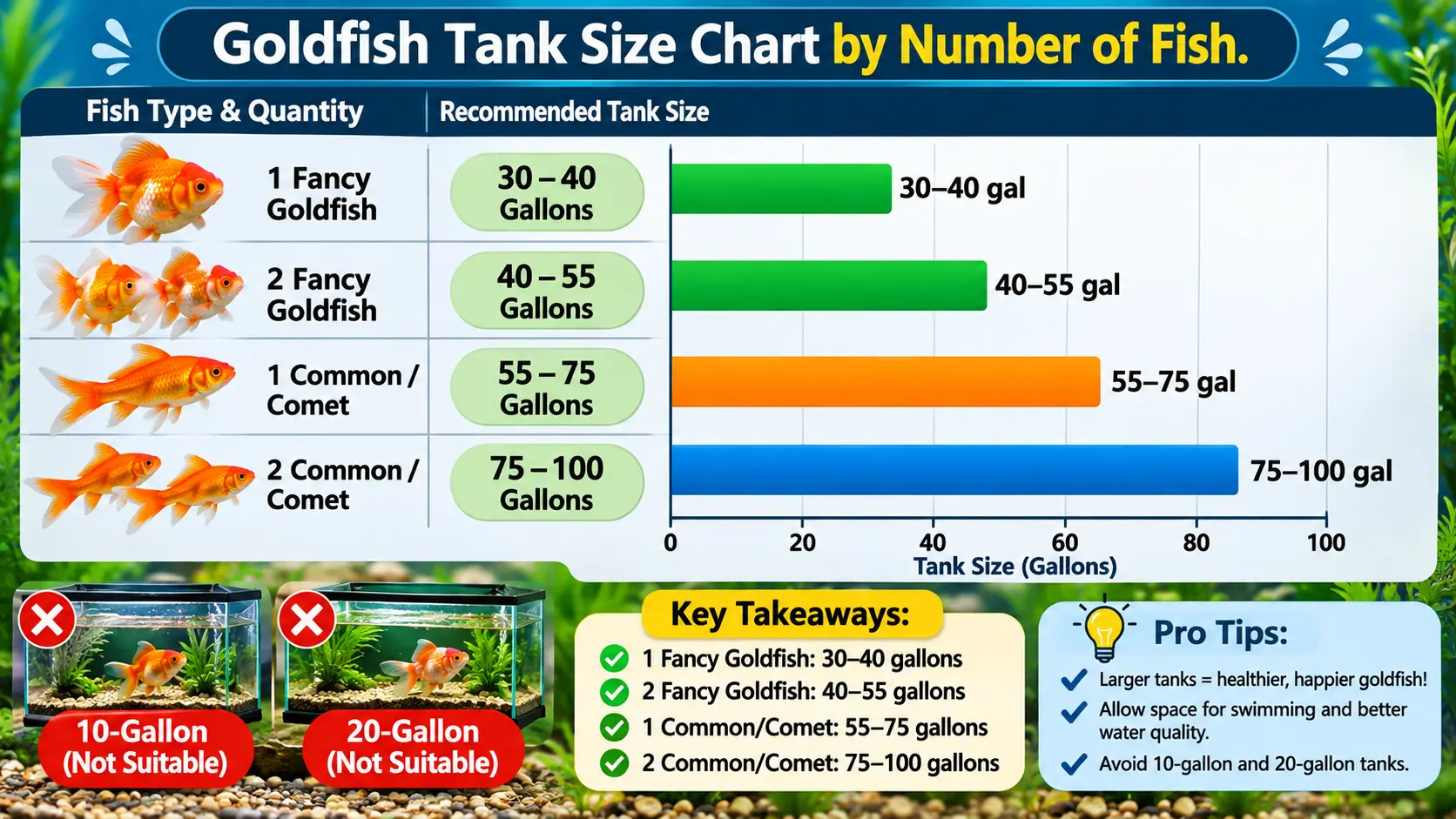
Goldfish Tank Size Chart by Number of Fish
This chart assumes healthy adult fish, strong filtration, regular water changes, and enough open swimming space. It is a stocking guide, not permission to overcrowd a tank.
| Number of goldfish | Fancy goldfish | Common, comet, or shubunkin |
|---|---|---|
| 1 goldfish | 30–40 gallons | 55–75 gallons |
| 2 goldfish | 40–55 gallons | 75–100 gallons |
| 3 goldfish | 55–75 gallons | 100–125 gallons |
| 4 goldfish | 75 gallons or more | 125 gallons or more |
| 5–6 goldfish | 90–125 gallons or more | Pond recommended |
The number of goldfish matters because each additional fish adds waste. More fish in the tank means more ammonia, more demand on the filter, and less room for each fish to swim. If you add fish later, upgrade the tank and filtration before the aquarium becomes crowded.
How Big Should a Goldfish Tank Be for Two or More Goldfish?
For two goldfish, the right answer depends on the type.
- Two fancy goldfish: Start with a 40- to 55-gallon tank.
- Two common or comet goldfish: Start with a 75- to 100-gallon tank.
- A mix of fancy and single-tail goldfish: Plan for the larger, faster fish. In practice, this usually means a very large tank or separate housing.
Two fancy goldfish can live well together in a 40-gallon tank if the aquarium is wide, well filtered, and properly maintained. However, a 55-gallon tank gives them more room to grow and makes water quality easier to manage.
Two common goldfish need much more space. They are active swimmers, produce a lot of waste, and can become large adult fish. A 75-gallon tank is a better minimum than a 30-gallon or 40-gallon tank, but a pond remains the best long-term option for many single-tail goldfish.
Do not add fish just because the tank looks empty. Juvenile goldfish grow quickly, and an aquarium that seems spacious today may become crowded within a year.
Does Goldfish Size Affect Aquarium Requirements?
Yes. The size of the fish affects the size of the tank, the filter, the swimming space, and the amount of waste in the water.
Goldfish grow throughout much of their lives. A small fish does not mean a small adult fish. When kept in good conditions, goldfish can reach a large size. INJAF explains that fully grown fancy goldfish can reach around 30 cm in length and height, while common goldfish can also reach 30 cm or more and become very heavy.
A larger fish produces more waste through its gills and feces. This is called bioload. High bioload can cause ammonia and nitrite to build up, which stresses fish and increases disease risk. Chewy also notes that goldfish produce a large amount of waste compared with many tropical fish, making water quality decline quickly in undersized aquariums.
Why Goldfish Need Larger Tanks Than You Might Expect
Goldfish need larger tanks for four main reasons: waste, oxygen, swimming space, and long lifespan.
First, goldfish eat often and produce a lot of waste. A small tank cannot dilute that waste well. Even a strong filter cannot fix an aquarium that is too small for the number of fish inside it.
Second, goldfish need oxygen. A wide tank has more surface area, which helps oxygen enter the water and carbon dioxide leave it. The RSPCA explains that wide tanks are better than tall tanks because they offer more surface area for gas exchange.
Third, goldfish need room to swim around, turn, explore, and rest. A narrow tank may hold enough water on paper but still fail because the fish cannot move naturally.
Fourth, goldfish are long-lived pets. Fancy goldfish can live 10–15 years or more, while common goldfish can live more than 20 years with proper care. Choosing a properly sized tank is part of responsible pet fish ownership, not an optional upgrade.
What Is the Best Tank Shape and Dimensions for Goldfish?
The best goldfish tank is long, wide, and relatively shallow, rather than tall and narrow. Goldfish swim horizontally, so tank length and floor space matter more than height.
A 40-gallon breeder tank is often a better choice than a tall 40-gallon show tank because it provides a larger footprint. The extra surface area improves oxygen exchange and gives fish more room to cruise, turn, and forage.
When choosing a tank, look for:
- A long swimming runway, especially for common and comet goldfish.
- A wide base so fish can turn without bumping into décor or glass.
- Enough open space for plants, hides, and enrichment without blocking movement.
- A secure lid, since goldfish can jump when startled.
- A sturdy stand that can safely support the filled aquarium.
A 30-gallon tank, 40-gallon tank, or larger aquarium should never be chosen only by gallon number. Two tanks with the same volume can perform very differently if one is long and shallow while the other is tall and narrow.
Can Goldfish Live in Small Tanks or Fish Bowls?
No. Goldfish should not live in fish bowls, jars, or very small tanks.
Goldfish bowls usually lack enough water volume, filtration, surface area, and stable temperature. They also make it difficult to maintain safe ammonia and nitrite levels. The RSPCA specifically identifies goldfish bowls, jars, and decorative tanks as unsuitable because they are too small, lack efficient filtration, have low surface area, and can experience rapid temperature changes.
The idea that goldfish grow only to the size of their tank is a harmful myth. A goldfish may grow more slowly in a small tank, but poor water quality, stress, and restricted movement can damage its health. Goldfish do not simply stop growing because the tank is small; their bodies may be stunted while their organs continue to grow, leading to serious welfare problems.
If you already have a goldfish in a bowl, the best action is to upgrade it as soon as possible. Move the fish to a properly cycled, filtered aquarium that matches its adult needs.
How to Set Up and Maintain the Right-Sized Goldfish Tank
A large tank is only part of good goldfish care. Filtration, water quality, oxygen, and swimming space all work together.
Choosing the Right Filter and Filtration Capacity
Goldfish require strong filtration because they are messy fish. Choose a filter rated for at least the full tank volume, and many fish keepers prefer a filter rated for several times the tank volume.
A good setup includes:
- Mechanical filtration to remove particles.
- Biological filtration to process ammonia and nitrite.
- Regular maintenance to keep water moving and media clean.
- Aeration from a sponge filter, air stone, or spray bar.
Do not rinse biological filter media under tap water. Chlorine can kill the beneficial bacteria that keep the tank safe. The RSPCA advises cleaning filter media in removed aquarium water and testing for ammonia and nitrite, which should both be 0 mg/L.
Maintaining Water Quality and Oxygen Levels
Cycle a new aquarium before adding fish whenever possible. Fishless cycling gives beneficial bacteria time to establish before fish produce waste.
Use a liquid test kit to check ammonia, nitrite, nitrate, pH, and temperature. Clear water does not always mean healthy water. Perform regular partial water changes, remove uneaten food, and avoid overfeeding.
Goldfish are coldwater fish, not tropical fish. They generally do well in cool, stable water. Avoid placing the aquarium beside a sunny window, radiator, or heat source, because temperature swings can stress fish.
Creating Enough Swimming Space
Keep décor simple at first. Use smooth rocks, driftwood, silk plants, or sturdy live plants, and leave a clear swimming lane across the tank.
Avoid sharp ornaments, narrow caves, or crowded layouts. Goldfish like to explore and forage, but they need open water to swim freely. A tank without enough open space can make even a large aquarium feel cramped.
Extra Section: Stocking Mistakes New Fish Keepers Make
Many new fish keepers choose a tank based on how many fish they want today. A better approach is to plan for the adult fish you will have in two to five years.
Common mistakes include:
- Buying a 10-gallon tank for a goldfish.
- Keeping one goldfish alone when it would benefit from compatible company.
- Adding fish before the aquarium has cycled.
- Using the fish-per-gallon rule without considering adult size.
- Putting fancy and common goldfish together in a small tank.
- Relying on a filter alone instead of regular water changes.
- Buying a tall tank with too little floor space.
If you are new to keeping fish, start with fewer fish and a larger tank. It is easier to maintain stable water in a bigger aquarium than in a smaller one.
Minimum Size Tank for Goldfish – FAQs
How big of a tank do goldfish need?
One fancy goldfish needs at least a 30-gallon tank, while one common, comet, or shubunkin goldfish needs at least 55–75 gallons. More fish require more space, stronger filtration, and regular water changes.
What size tank for goldfish is best for beginners?
A 40-gallon breeder-style tank is a good beginner choice for two fancy goldfish. It is easier to keep stable than a 10 gallon or 20-gallon tank and provides more room for adult fish.
What size tank does a goldfish need?
What is the minimum tank size for goldfish? The size needed depends on the variety. Fancy goldfish need a minimum of 30 gallons each, while single-tail goldfish need much more room because they grow larger and swim faster.
How to keep goldfish small?
You should not try to keep goldfish small by using a small tank. Poor conditions can slow growth and harm their health. Provide a properly sized aquarium, a healthy diet, clean water, and enough space for normal growth.
Can 2 goldfish live in a 20-gallon tank?
A 20 gallon tank is not a suitable permanent home for two adult goldfish. It may temporarily house very small juvenile fish, but they will need a much larger tank soon.
Can goldfish live in a 10-gallon tank?
No. A 10-gallon tank is too small for an adult goldfish. It may be useful only as a temporary quarantine or grow-out setup, not as a permanent home.
How many goldfish can I keep in a 30-gallon tank?
One adult fancy goldfish is the safest long-term stocking level for a 30-gallon tank. Two small fancy goldfish may work temporarily, but a 40- to 55-gallon tank is a better plan.
Can I keep one goldfish alone?
Goldfish are social fish and generally do better with compatible company. If you keep one fish, use a larger tank and provide enrichment, but plan to add a compatible goldfish when space and filtration allow.
Do goldfish grow to the size of their tank?
No. Goldfish don’t stop growing because a tank is small; poor conditions may stunt them and harm their health. Provide a larger size tank based on adult size, filtration, and water quality.
Is a 2-gallon tank big enough for a goldfish?
No. A 2-gallon tank is far too small for a goldfish to swim around, filter safely, and stay healthy. It is not suitable as a permanent home for a beginner fish.
Can I put 2 goldfish in a 3-gallon tank?
No. A 3-gallon tank is too small for 2 goldfish. Goldfish need a medium size or larger aquarium with strong filtration; small tanks pollute quickly and restrict swimming.
Can 1 goldfish live in a 5-gallon tank?
No. A 5-gallon tank is not a suitable permanent home. One goldfish needs much more space, and gallons per fish should be based on adult size, waste production, and filtration—not juvenile size.
Do goldfish stop growing in a small tank?
No. Goldfish may grow slowly in a small tank, but they do not safely stop growing. Their bodies can become stunted while organs continue developing, so upgrade to one tank large enough for adult fish.
What tank requirements besides size do goldfish need?
Goldfish need strong biological filtration, aeration, stable cool water, regular water testing, and weekly partial water changes. A wide tank with open space also helps additional goldfish live comfortably and safely.
Can I put 1 goldfish in a 10-gallon tank?
No. A 10-gallon tank is too small for an adult goldfish. One fancy goldfish needs at least a 30-gallon tank, while common and comet goldfish need much more space, strong filtration, and regular water changes.
How many goldfish can live in one tank?
It depends on the variety and tank size. A 30-gallon tank can house one adult fancy goldfish; a 40–55-gallon tank can house two. Common, comet, and shubunkin goldfish need a 75-gallon tank or larger, or a pond.
Conclusion
Choosing the right tank size for goldfish is one of the most important decisions you will make as a fish keeper. A goldfish is not a decoration for a bowl or a tiny starter tank. It is a long-lived aquarium fish that needs clean water, strong filtration, oxygen, and enough room to swim, turn, and grow.
For fancy goldfish, begin with at least a 30-gallon tank for one fish or a 40- to 55-gallon tank for two. For common, comet, and shubunkin goldfish, plan for a 75-gallon tank or larger, or provide a properly filtered pond. Avoid the fish-per-gallon rule and always plan around adult size, not the size of juvenile goldfish at the store.
A larger tank may cost more at first, but it makes goldfish care easier, improves water stability, and supports better fish welfare. When you choose the right tank size from the start, you give your pet goldfish the best chance to live a long, active, and healthy life.
You might also like
- What Size Tank Do I Need for two Goldfish: Stop Overcrowding!
- How Many Goldfish in a 5 Gallons Tank: (The Golden Rule)
- Can Goldfish Eat Bettas Food? (7 Best Fish Food Alternatives)
- How Many Goldfish Per Gallon water tank? #1 Easy Calculation Guide
- Can Bettas Live with Golden fish? (You Might Be Shocked)
- How Big Does Goldfish Get in Aquarium: Goldfish Myths & Facts (Debunked)
- 5 Surefire Golden fish Breeding Signs You Need to Know!
- What Size Tank for a Goldfish: A Beginner’s Complete Guide
- Fish Tank Requirements for Goldfish: (Care Basics & Expert Tips)