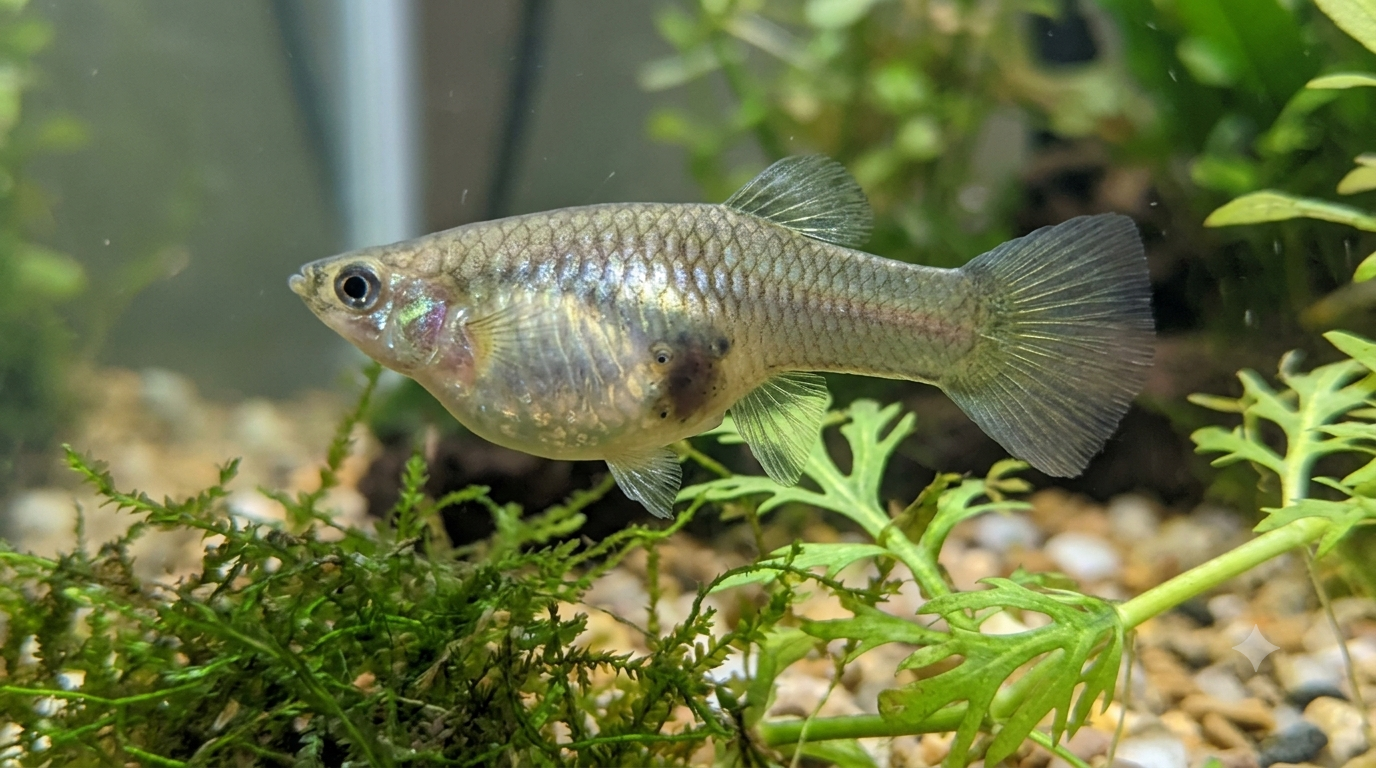
How many mollies should be kept together in a tank? For most home aquariums, keep 3–5 mollies together. A practical beginner group is one male with two or three females, provided the tank is at least 20 gallons and properly filtered.
If you want to avoid babies, keep females only or males only. Mollies are social, active livebearers, so a single fish often becomes restless, while a suitable group helps them behave more naturally.
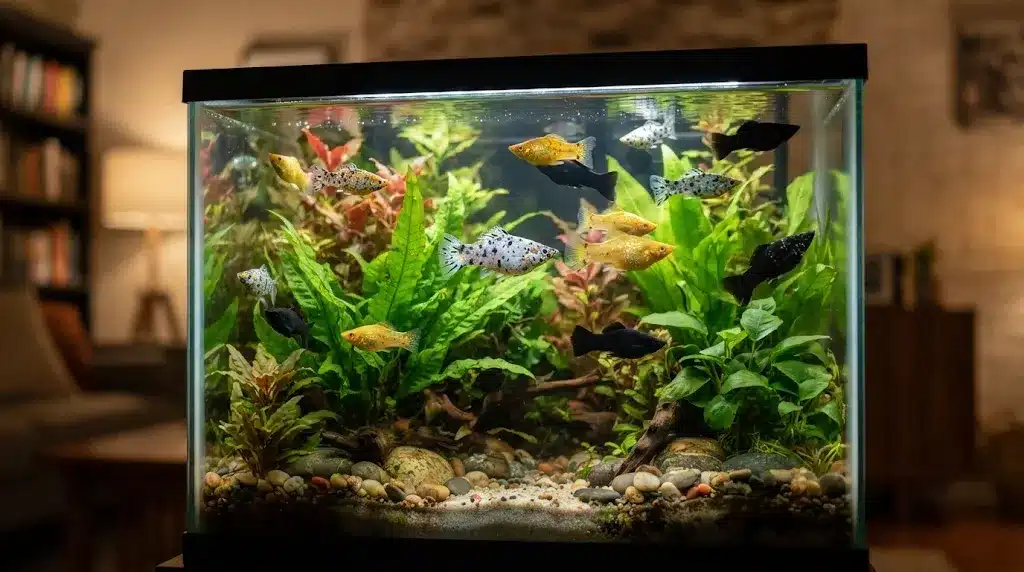
Mollies should be kept together in a group because they are active community fish that use open swimming space, plants, and companionship to feel secure. The right molly fish group size depends less on a fixed rule and more on the molly species, adult size, sex ratio, filtration, and whether you plan to breed them.
How Many Mollies Should Be Kept Together?
Mollies are social, peaceful fish that thrive when kept in a small group rather than alone. However, keeping too many mollies in one aquarium can lead to overcrowding, poor water quality, and increased stress.
The ideal number of mollies depends on your tank size, filtration system, and the ratio of males to females. For most beginners, starting with 3–6 mollies in a properly sized aquarium is a good choice, provided the tank has enough swimming space and a reliable filtration system.
A well-maintained tank with a balanced group of mollies will help them stay active, healthy, and display their natural social behavior.
The Ideal Number of Mollies for a Small Group
The best number of mollies in a tank is usually 3–5 for a beginner with a 20-gallon or larger aquarium. A group of 3 molly fish is the practical minimum: 1 male to 2 females if you keep both sexes. Four mollies give you a little more social balance, while five mollies work best in a 29-gallon or larger tank with strong filtration.
If you ask, “How many molly fish should I have?” start with one male and two females only if you are prepared for babies. Otherwise, choose three or four females or three or four males, depending on the tank size and the temperament of the fish.
Why Mollies Prefer Living in Groups
Mollies are social fish, although they are not tightly schooling fish in the same way as many tetras. They still benefit from having other mollies nearby because a group gives them normal social activity and reduces the chance that one fish becomes the constant target of attention.
A single molly can live, but it may hide more, swim restlessly, or show stress behaviors if the aquarium does not provide enough enrichment. Plants, open swimming room, stable water quality, and appropriate tank mates all help mollies feel safe.
What Is the Best Male-to-Female Ratio for Mollies?
The best molly fish male-to-female ratio is 1 male to 2 or 3 females. This ratio spreads the male’s attention across several females, which lowers harassment and gives females time to rest, feed, and swim normally.
Avoid keeping one male with one female for long periods. A single female may be chased repeatedly, which can cause stress, fin damage, exhaustion, and poor health. If you keep 2 males, provide a much larger tank, plenty of plants, and several females in the tank; otherwise, male competition can become aggressive.
| Group type | Recommended setup | Main concern |
|---|---|---|
| Mixed sex | 1 male to 2–3 females | Frequent breeding and fry |
| Females only | 3–5 females | No males, but confirm sex before buying |
| Males only | 3–4 males in a large, planted tank | Possible male-to-male aggression |
| One molly | Not ideal | Less natural social behavior |
Can You Keep Only Two Mollies Together?
Yes, two mollies can live together, but it is not the best long-term setup for a mixed-sex pair. One male and one female will likely breed, and the female may receive too much mating attention.
Two females can get along well in a sufficiently large tank, especially if they were raised together and have plants, open space, and stable water conditions. Still, three or more mollies is generally a better social setup because it prevents one fish from becoming the sole focus of another fish’s attention.
Can Male Mollies Live Together Without Females?
Can male mollies live together? Yes, but success depends on space, cover, and individual temperament. An all-male group avoids babies, but males can compete for dominance, particularly in a small or bare aquarium.
Keep at least three males, use a 29-gallon or larger fish tank when possible, and add plants, rocks, driftwood, and visual barriers. Do not assume that every male will get along; monitor chasing, torn fins, hiding, and reduced feeding. If two males continually bully another molly, separate the aggressive fish.
How Many Mollies Can You Keep in a 10, 20, or 30-Gallon Tank?
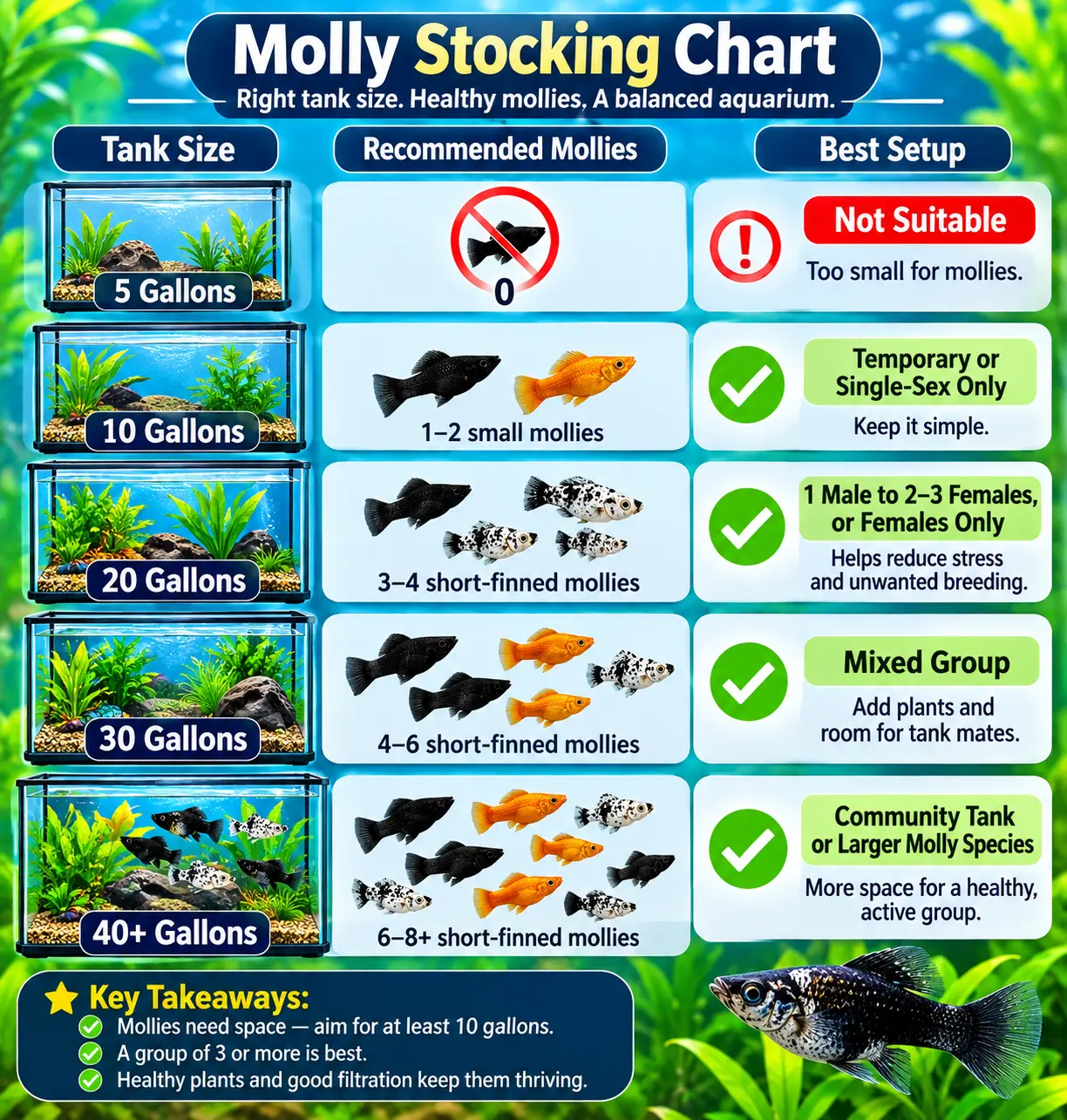
A common question is, “How many mollies per gallon?” A useful rule of thumb for small, short-finned molly species is one molly per 3–5 gallons, but this is only a starting point. Adult size, filter capacity, plants, tank mates, and breeding plans matter more than tank volume alone.
| Tank size | Practical molly stocking | Best setup |
|---|---|---|
| 5 gallon tank | Not recommended | A tank is too small for an active molly group |
| 10-gallon tank | One or two small mollies at most | Not ideal; better for a different small fish species |
| 20-gallon tank | 3–4 short-finned mollies | 1 male to 2–3 females, or 3–4 females |
| 30-gallon tank | 4–6 short-finned mollies | More room for plants, tank mates, and fry management |
| 40+ gallon tank | 6–8+ mollies | Better for a mixed community tank or larger molly species |
PetMD notes that most molly species can house up to two mollies in a 10-gallon tank, but recommends adding at least 3 gallons per additional fish beyond the first two. It also recommends at least a 30-gallon aquarium for larger sailfin mollies. petmd
A 5 gallon tank is too small for a group because mollies need room to swim, and waste builds quickly in a small volume. A 10-gallon tank can temporarily house one or two small mollies, but it leaves little room for error, plants, tank mates, or young fish.
What Happens If You Keep Too Many Mollies Together?
Overstocking raises the bioload, meaning more fish waste enters the water. Poor water quality can weaken a molly’s immune system and increase the risk of stress and disease.
Common warning signs include:
- Constant chasing, nipping, or hiding.
- Clamped fins, faded color, rapid breathing, or loss of appetite.
- Females being harassed by one or more males.
- Fry appearing unexpectedly and crowding the tank.
- Ammonia, nitrite, or nitrate readings rising despite regular water changes.
If your tank is too small, do not simply add more filtration and assume the problem is solved. A filter removes waste and supports beneficial bacteria, but it cannot create swimming space. Upgrade the aquarium, rehome extra fish, or keep fewer mollies.
Can Different Types of Mollies Live Together?
Different molly species and color varieties can often live together if they have similar needs and a similar adult size. Common short-finned mollies, Dalmatian mollies, black mollies, and balloon mollies may share a community tank, but balloon mollies can have special care needs because of their body shape.
Sailfin mollies are a different matter. They grow much larger than many common molly varieties, so they need a much larger tank and should not be stocked using the same per-fish estimate as small short-finned mollies.
Avoid mixing mollies with aggressive or fin-nipping fish. Peaceful tank mates such as platies, guppies, swordtails, tetras, corydoras, and rasboras can work in a large, well-planted community tank
Do Mollies Need Other Fish for Companionship?
Mollies do not need a huge crowd, but they generally do better with at least a few compatible tank mates or other mollies.
They are active, curious fish that use the middle and upper areas of the aquarium, so they need open swimming space as well as plants and hiding places.
A guppy can make a suitable companion in a peaceful community aquarium because both are livebearers and prefer similar warm, hard water. However, guppies breed too, so a mixed livebearer tank can become crowded quickly.
How to Tell If Your Mollies Are Happy and Comfortable in a Group
Healthy mollies swim actively, eat well, show clear eyes, and keep their fins open rather than clamped. They should explore the tank, graze on algae, and interact without one fish being chased nonstop.
Set up the tank with:
- A reliable filter sized for the tank’s bioload.
- A heater that keeps the water stable.
- Live or artificial plants arranged around the edges.
- Open swimming space in the center.
- Hiding places made from plants, driftwood, or decor.
- A suitable substrate, such as rinsed sand or gravel.
- Regular water tests and partial water changes.
Feed a varied omnivore diet: quality flakes or pellets, blanched vegetables, and occasional frozen or freeze-dried foods. Mollies also graze on alga and biofilm, but algae alone will not house or feed a healthy group.
How to Stock Mollies the Right Way
Before buying, decide whether you want fry. Mollies are livebearers, so a mixed-sex group can breed often. A female can release free-swimming baby fish, and adults may eat the young unless dense plants or a separate nursery tank provide cover.
For a mixed group, use 1 male to 2 or 3 females. For a no-baby group, keep females only or males only. Never add fish gradually without checking water parameters; new fish change ammonia, nitrite, nitrate, and pH levels, so monitor the water after stocking.
Keep the aquarium cycled before adding fish. Use a filter that turns over the tank volume several times per hour, maintain stable temperature with a heater, and perform routine water changes. PetMD recommends a filter capable of processing the tank water at least four times per hour and regular testing of ammonia, nitrite, nitrate, and pH.
Frequently Asked Questions About Keeping Mollies Together
Can a Molly Fish Live Alone?
A molly can survive alone, but it is not the most natural setup. If you keep one molly, provide a large, planted, stable aquarium and consider adding compatible peaceful community fish rather than leaving the fish completely alone.
Do Mollies Get Lonely?
Mollies are social and may become less active or more stressed without companions. A group of at least three, or a well-chosen community tank, is usually better than keeping a single fish.
How Many Mollies Should a Beginner Start With?
A beginner should start with 3–4 mollies in a 20-gallon or larger tank. Choose three females, three males, or one male with two females based on whether you want babies.
Will Mollies Fight Over Territory?
Mollies are usually peaceful, but males can become aggressive while competing for females or dominance. Plants, open space, a proper sex ratio, and enough tank size reduce conflict.
How Many Mollies Should Be Kept Together in a 20 Gallon Tank?
How Many Mollies Should Be Kept Together in a 20 gallon tank? Keep 3–4 short-finned mollies in a 20-gallon aquarium. A balanced beginner group is 1 male to 2 females, but this will produce fry. If you do not want babies, keep 3–4 females or 3–4 males instead.
Can I keep 2 mollies in a 10-gallon tank?
You can keep two small, short-finned mollies in a 10-gallon tank, but it is tight. Use 1 male to 1 female only if you accept fry; otherwise, choose 2 females. A bigger tank is better.
Can 3 mollies live in a 5-gallon tank?
No. Three mollies cannot live comfortably in a 5-gallon tank because they need room to swim and produce a high bioload. Keep fish in at least a 20-gallon tank, with about 3–5 gallons per fish for small molly species.
Can all molly fish live together?
Most molly species can live together if they are peaceful, similar in size, and kept in a large enough tank. Avoid mixing large sailfin mollies with small varieties, and use 2–3 females per male to reduce harassment.
Do mollies like to stay at the top of the tank?
Mollies often swim near the top because they feed there and may nibble algae or biofilm. If they constantly gasp at the surface, check oxygen, water quality, and filtration; poor conditions can cause stress and disease.
Do mollies need to live in groups, and what is the minimum group size?
Mollies are social and do better in groups. Keep at least 3 mollies, ideally 1 male with 2–3 females or a group of females. A single female may face too much attention from a male, while many females spread harassment and lower stress.
Do mollies like to stay at the top of the tank?
Mollies often swim near the top to feed and graze on algae, but they should also use the middle and bottom of the tank. Constant surface gasping can signal low oxygen, poor water quality, or stress and disease.petmd
Can mollies live with other fish?
Yes. Mollies are peaceful community fish that can live with similar-sized, non-aggressive tank mates such as guppies, platies, tetras, corydoras, and rasboras. Avoid fin-nipping or aggressive fish, and provide a big tank with plants and hiding places.
Conclusion
How Many Mollies Should Be Kept Together in a 20 gallon tank? Keep 3–4 short-finned mollies in a 20-gallon aquarium. The most balanced beginner group is 1 male to 2 females, but this combination will breed, so plan for fry or choose a single-sex group instead. Three females, three males, or four mollies can all work when the aquarium has strong filtration, live plants, open swimming space, and stable water quality.
Avoid a 5 gallon tank or a crowded 10-gallon tank because mollies need room to swim, grow, and establish a comfortable social group. Monitor chasing, feeding, breathing, and water parameters after adding fish. If one molly hides constantly or females face repeated harassment, adjust the sex ratio, add cover, or reduce stocking.
With the right tank size, peaceful tank mates, and a practical breeding plan, mollies can thrive as colorful, active community fish
You might also like
- How Long Do Mollies Live for? 5 Tips to Prolong molly fish lifespan (mollies lifespan)
- What Do Dalmation Mollies Eat: 7 Best Molly Fish Food (List)
- How Big Do Dalmation Mollies Get? Size & Care Guide (FAQ)
- Are Molly Fish Aggressive and Fin Nippers? (9 Secret Facts)
- Molly Fish Care guide: Complete Expert’s Care & Breeding Hacks
- Dalmatian Balloon Molly Fish: Size & Food (Ultimate Guide)
- How Many Fish for a 10 Gallon Tank? A Complete (Beginners guide)