How big of a tank does a betta fish need? A betta fish needs at least 5 gallons of water for a healthy long-term home. A 10-gallon tank is even better for most beginners because it stays warmer, cleaner, and more stable with less effort. Betta fish tank size affects water quality, swimming room, temperature control, and how naturally your betta behaves.
Many stores still sell bowls and tiny “betta kits,” but those setups make life harder for the fish. A betta may survive in a small container, yet survival is not the same as living comfortably. Betta splendens are tropical freshwater fish that need warm, clean, gently filtered water, open space to swim, and places to rest near the surface.
Betta tank size at a glance
| Tank size | Best use | Is it suitable? |
|---|---|---|
| Under 1 gallon | Temporary transport only | No |
| 1 gallon | Emergency holding only | No |
| 2.5 gallons | Short-term holding with intense care | Not ideal |
| 3 gallons | Temporary setup only | Not ideal |
| 5 gallons | Minimum for one healthy adult betta | Yes |
| 10 gallons | Best beginner and long-term choice | Yes |
| 20 gallons | Excellent for a planted tank or carefully chosen tank mates | Yes |
A 5-gallon tank is fine for a betta when it includes a heater, gentle filtration, a lid, and regular care. A 10-gallon tank gives the fish more room to spread out and makes the aquarium more forgiving when life gets busy.
How Big of a Tank Does a Betta Fish Need?
The minimum betta fish tank size for one adult betta is 5 gallons. A 10-gallon aquarium is the preferred size because it provides more swimming space and keeps water conditions steadier.
Tank size tank for a betta matters because a betta’s waste breaks down into ammonia. In a small tank, ammonia can rise quickly and harm the fish’s gills, fins, and immune system. More water dilutes waste, supports beneficial bacteria, and gives you more time to catch problems before they become dangerous.
Bettas are active, curious fish. They patrol their territory, investigate plants, rest on leaves, and swim to the surface to breathe air through their labyrinth organ. A cramped tank limits those behaviors and can lead to stress, clamped fins, lethargy, and repeated illness.
What is the Minimum Tank Size for a Betta Fish?
The practical minimum tank size for a single betta is 5 gallons. Some care sheets list 2.5 gallons as a minimum, but 5 gallons is the safer, easier long-term choice because it leaves room for a heater, filter, plants, and stable water quality.
1-gallon tanks
A 1 gallon tank is too small for permanent betta care. It cannot hold a stable temperature well, leaves very little room for equipment, and can develop harmful ammonia levels quickly.
A 1-gallon container may work for short transport or an emergency, but it should not be a betta’s permanent home.
2.5-gallon tanks
A 2.5 gallon tank is better than a bowl, but it is still a compromise. It can technically hold a heater and small filter, but the water volume leaves little margin for overfeeding, missed maintenance, or a temperature swing.
If you already own a 2.5-gallon tank, use it only as a temporary setup while you prepare a larger aquarium. Add a heater, gentle filter, thermometer, secure lid, and live or silk plants, then upgrade as soon as possible.
5-gallon tanks
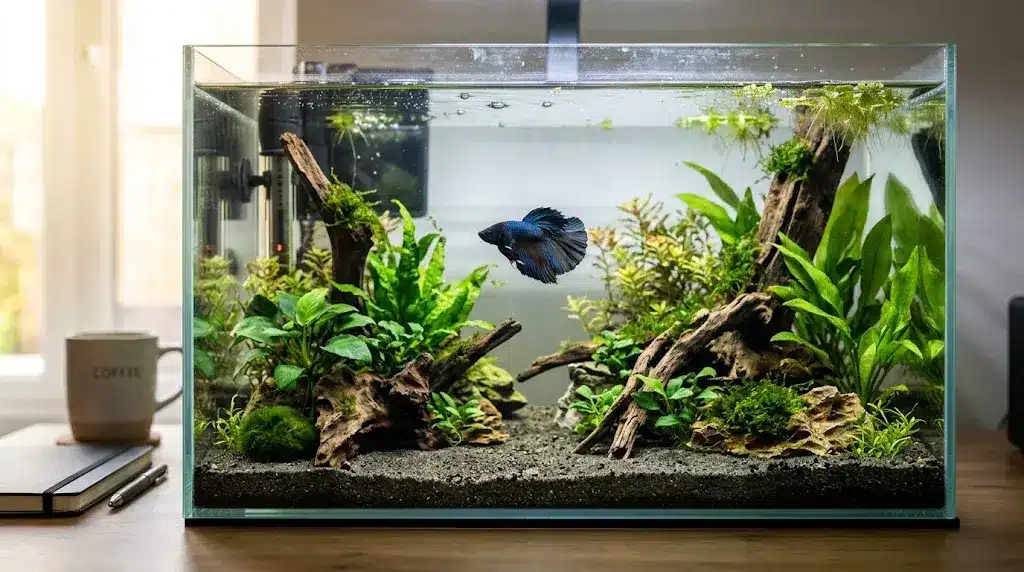
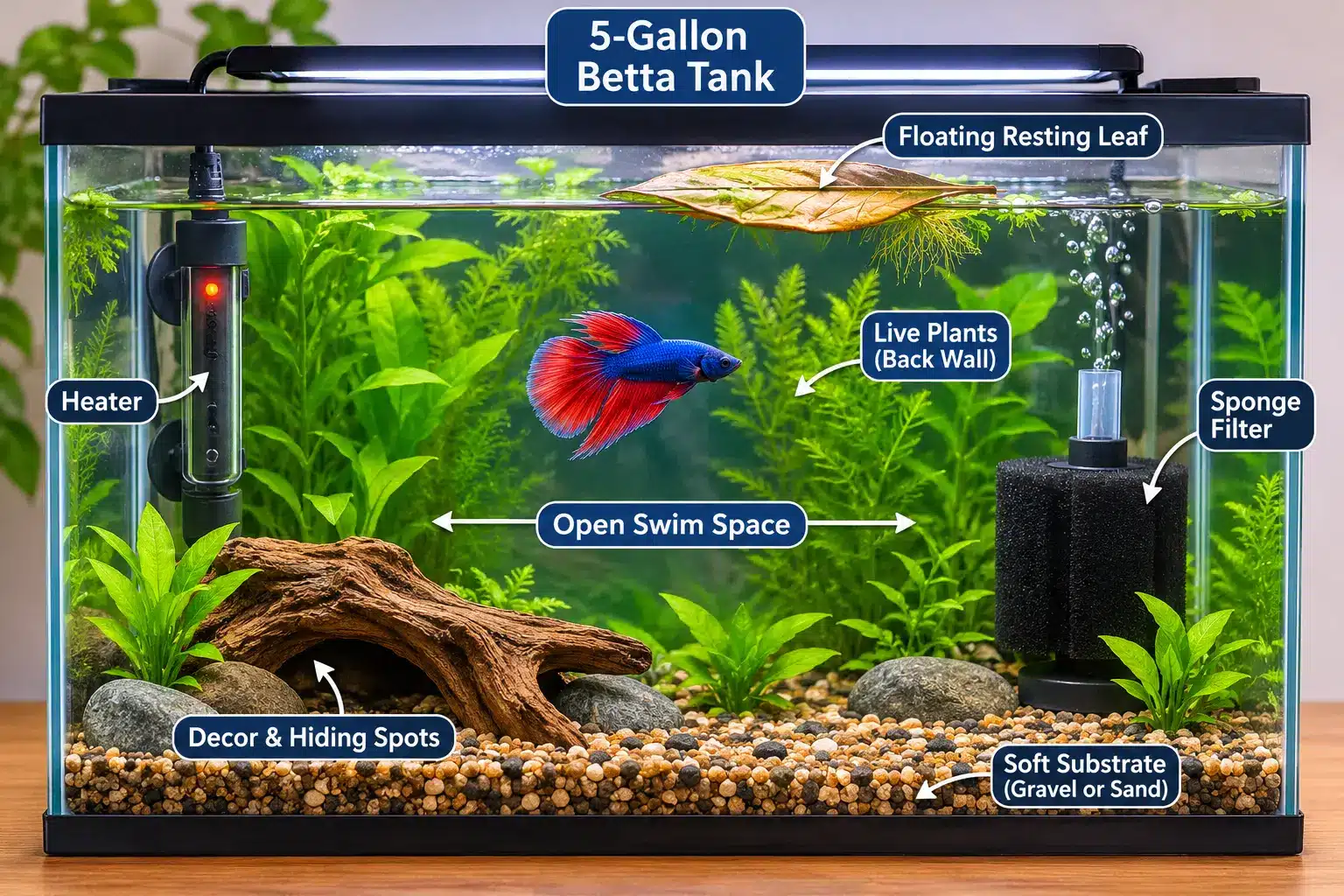
A 5-gallon betta tank is the smallest size most experienced keepers recommend for one betta. It provides enough room for normal swimming, a heater, a low-flow filter, plants, and a resting area near the surface.
For a single betta, 5 gallons is enough when the tank is properly maintained. It is not enough space for a community aquarium or for keeping two bettas together.
Is a 5-Gallon Tank Big Enough for a Betta Fish?
Yes. A 5-gallon tank is enough for one betta when it is cycled, heated, filtered gently, and cleaned on a regular schedule. Aquarium Co-Op specifically recommends a 5-gallon tank as a great starting size for a single betta.aquariumcoop
A 5-gallon setup works well for a beginner who can commit to weekly testing and water changes. It is compact enough for a desk or bedroom, but large enough to support the basic equipment a betta needs.
Best 5-gallon betta tank setup
Use this simple layout:
- A rectangular 5-gallon aquarium with a lid.
- An adjustable heater and thermometer.
- A sponge filter or adjustable-flow filter.
- A soft substrate such as fine sand or smooth gravel.
- Live plants such as Java fern, Anubias, or floating plants.
- A few silk plants if live plants are not an option.
- A betta log, ceramic cave, or broad leaf for resting.
- Water conditioner and an aquarium test kit.
A betta needs a tank with lots of cover, but it also needs an open swimming lane. Place taller plants and decorations toward the back and sides, leaving the front and middle open.
Is a 10-Gallon Tank Better for a Betta Fish?
Yes. A 10-gallon betta tank is better than a 5-gallon tank for most owners because it is more stable and easier to manage over time. PetMD notes that larger fish tanks tend to keep temperature and water chemistry steadier.
A 10-gallon aquarium does not require twice the work of a 5-gallon tank. In many cases, it requires less frequent intervention because waste and temperature changes happen more slowly.
5-gallon versus 10-gallon tank
| Feature | 5-gallon tank | 10-gallon tank |
|---|---|---|
| Space for one betta | Good | Excellent |
| Temperature stability | Fair | Better |
| Water-quality margin | Smaller | Larger |
| Maintenance frequency | More frequent | Less frequent |
| Planting options | Limited | More flexible |
| Community fish potential | No | Possible with careful planning |
| Best for | One betta in a compact space | Beginners and long-term care |
Aquarium Co-Op recommends 5 to 10 gallons for a betta and explains that more water gives the fish extra swimming room while allowing longer intervals between cleanings.
If you have the space and budget, get a 10-gallon tank. It gives a new betta a better chance to settle in, gives you room for live plants, and makes future upgrades easier.
Can Betta Fish Live in Small Bowls or Tiny Tanks?
No. Betta fish should not live in bowls, vases, jars, or tiny decorative tanks. These containers usually lack enough water volume for stable heat, safe filtration, and healthy water quality.
The idea that bettas live in puddles is misleading. Wild bettas may occupy shallow water, but those habitats are wide, planted, and refreshed by natural water movement. A small bowl on a shelf is not the same environment.
Why bowls fail
- Water temperature changes quickly.
- Ammonia can build up fast.
- There is little space for a filter and heater.
- The fish has limited room to swim and explore.
- Frequent full water changes can disrupt the tank’s biological balance.
A betta may breathe atmospheric air, but that does not remove the need for clean, heated, filtered water. The labyrinth organ is an adaptation, not a replacement for proper aquarium care.
What Shape of Tank is Best for a Betta Fish?
Choose a long, low, rectangular aquarium rather than a tall, narrow tank. Bettas swim horizontally more than vertically, so a wider footprint gives them more usable space.
A standard 10-gallon tank often has a footprint around 20 by 10 inches, which creates a useful horizontal swimming lane. A tall cube may hold the same number of gallons but offer less practical swimming room.bettafishh
What to look for
- A long front-to-back swimming area.
- Easy access to the water surface.
- Room for a heater and gentle filter.
- Space for plants and hiding places.
- A secure lid to prevent jumping.
- A tank you can clean without moving heavy decorations.
Avoid round bowls and very tall vases. They reduce surface area, make equipment placement difficult, and often create poor water circulation.
What Equipment Does a Betta Fish Tank Need?
A betta needs more than water and food. The right tank setup includes stable heat, gentle water movement, safe decor, and clean water.
Heater and thermometer
Bettas are tropical fish and need consistently warm water. PetMD recommends keeping the aquarium between 76 and 81 degrees Fahrenheit and using a thermometer to confirm the temperature stays in range.
A heater is important even in a warm room because room temperature can drop at night. Choose an adjustable heater sized for your aquarium and place the thermometer away from the heater so it shows the tank’s overall temperature.
Gentle filter
Use a sponge filter or a small filter with adjustable flow. Strong current can exhaust a betta, especially one with long, flowing fins.
Position plants, driftwood, or decor to break up the current. Your betta should be able to swim easily without being pushed around the tank.
Lid and lighting
Bettas can jump, so use a secure lid. A light helps plants grow and lets you observe your fish, but keep lighting on a consistent schedule rather than leaving it on all day.
Plants and hiding places
Use live plants, silk plants, a betta log, a cave, or broad leaves. Live plants improve the look of the aquarium and give the fish cover, while silk plants are a safer alternative to sharp plastic decorations.
Good plant choices include Java fern, Anubias, Amazon frogbit, and floating plants. Avoid rough or sharp artificial plants that could tear delicate fins.
Water conditioner and test kit
Use a betta water conditioner to remove chlorine and chloramine from tap water before it enters the aquarium. A liquid test kit helps you monitor ammonia, nitrite, and nitrate.
Do not rely on clear water alone. Ammonia and nitrite can be dangerous even when the aquarium looks clean.
How Many Betta Fish Can Live in One Tank?
Keep one male betta per tank. Male bettas are territorial and should not share open water with another male because fighting can cause serious injury or death.
A male and female should also not live together permanently. Breeding requires a separate, carefully managed setup and should not be attempted casually.
Female betta sororities
Female bettas can sometimes live in a group, called a sorority, but this is an advanced setup. It requires a large tank, heavy planting, multiple hiding places, careful monitoring, and a plan to separate fish if aggression begins.
A 5-gallon tank is not suitable for a sorority. For multiple bettas, plan on at least 5 gallons of space per fish, along with extra room for plants, sight breaks, and territory.
Betta tank mates
A 10-gallon tank can sometimes support a betta with a snail or carefully selected peaceful fish, but compatibility depends on the individual betta’s temperament. Aquarium Co-Op recommends 10 to 20 gallons with plenty of cover and live plants for community setups.
Avoid fin-nipping species such as tiger barbs and serpae tetras. Also avoid brightly colored or long-finned fish that may trigger aggression. chewy
A nerite snail or mystery snail can be a lower-risk tank mate in a larger, well-planted aquarium, but even snails need enough space and clean water.
How often Should You Clean a Betta Fish Tank?
Perform a partial water change rather than emptying and scrubbing the entire aquarium. For a 5-gallon betta tank, a 25 to 30 percent water change once a week is a sensible starting point; test the water and adjust based on ammonia, nitrite, and nitrate levels.
Use a gravel vacuum to remove waste from the substrate. Clean the filter only when flow slows, and rinse filter media in removed tank water rather than tap water so you preserve beneficial bacteria.
Weekly maintenance routine
- Test ammonia, nitrite, and nitrate.
- Check the thermometer and heater.
- Siphon debris from the substrate.
- Remove uneaten betta pellets and decaying plant leaves.
- Replace removed water with temperature-matched, conditioned water.
- Wipe algae from the glass if needed.
- Check the filter intake for blockages.
A new tank should be cycled before you add a betta. The nitrogen cycle depends on beneficial bacteria that convert ammonia into nitrite and then nitrate. A tank is safer to stock when ammonia and nitrite read zero and nitrate is present at a manageable level.
Frequently asked questions
Is a 1-gallon tank too small for a betta?
Yes. A 1-gallon tank is too small for permanent betta care because it cannot maintain stable temperature or safe water quality. Use it only for short-term transport or an emergency.
Can a betta fish live in a 2.5-gallon tank?
A betta can survive in a 2.5-gallon tank, but it is not the best long-term home. It can work only as a temporary setup with a heater, gentle filter, frequent testing, and regular water changes.
Is a 5-gallon tank enough for one betta?
Yes. A 5-gallon tank is enough for one betta when it has a heater, gentle filtration, a lid, plants, and consistent maintenance.
Do betta fish prefer tall or long tanks?
Bettas prefer long, low tanks because they swim horizontally and need easy access to the surface. A wide tank also gives you more room for plants, resting spots, and gentle filtration.
Does a bigger tank make betta fish happier?
A bigger tank can make a betta more comfortable because it provides more swimming space and more stable water conditions. The aquarium still needs proper heating, filtration, cover, and enrichment.
Can I keep a betta fish in a 10-gallon community tank?
Sometimes. A 10-gallon community tank can work with a calm betta and carefully selected tank mates, but a 15- to 20-gallon planted tank gives more room and reduces territorial stress.
How big of a tank do I need for 2 betta fish?
Two male bettas should never share open water. If you use a secure divider, plan on at least 10 gallons total so each side provides roughly 5 gallons, with separate heating and gentle filtration. bettafishh
Do betta fish like a cramped tank?
No. Bettas do not like cramped conditions. A small tank can cause stress, poor water quality, limited swimming space, and health problems.
Should a betta fish be in a big tank?
Yes, a larger tank is generally better as long as it has gentle flow, warm water, plants, and hiding places. A 10-gallon tank is an excellent size for most single bettas.
Is a 2.5-gallon planted tank big enough for a betta?
A planted 2.5-gallon tank is better than a bare bowl, but it is still smaller than the recommended long-term minimum. Plants help, but they do not replace adequate water volume, stable heat, and filtration.
How many liters for a betta fish?
A 5-gallon tank holds about 19 liters of water. A 10-gallon tank holds about 38 liters. For one betta, aim for at least 19 liters; 38 liters is the better target.
What is the ideal size for a single betta?
The ideal size for a single betta is 10 gallons. It gives the fish room to swim, supports stable water conditions, and leaves space for live plants and enrichment.
Is “one inch of fish per gallon” a good rule?
No. The “inch per gallon” rule is too simple for bettas and other freshwater fish. Adult size, waste production, activity level, temperament, filtration, and tank dimensions all matter more than a basic length-to-volume formula.
Can a betta live without a filter?
A betta can survive briefly without a filter, but it should not live long term in an unfiltered tank. Filtration supports the nitrogen cycle and helps prevent ammonia from building up.
Can a betta live without a heater?
Most bettas need a heater. They are tropical fish and become sluggish or stressed when water stays too cool.
What should I feed a betta?
Feed a high-quality betta pellet as the main diet. Offer a bloodworm occasionally as a treat, but do not overfeed; leftover food quickly increases waste and ammonia.
How often should betta fish be fed?
Feed adult bettas once daily, giving only what they finish in about two minutes. Offer a small fasting day weekly and avoid overfeeding.
How do I treat a sick betta fish?
Test water first, correct ammonia, nitrite, temperature, and water-quality problems, then isolate the fish if needed. Follow a fish-safe treatment plan or consult an aquatic veterinarian.
How do I cycle a betta fish tank?
Set up the filter, heater, and dechlorinated water, then add an ammonia source and monitor ammonia, nitrite, and nitrate. Add the betta only after ammonia and nitrite reach zero.
Why is a larger tank better for a betta fish?
Larger tanks dilute waste, hold temperature more steadily, offer more swimming room, and make maintenance easier. They also allow plants, hiding places, and safer future tank mates.
What happens if a betta lives in a tank that is too small?
Ammonia can build quickly, temperature can swing, and the fish may become stressed, lethargic, or sick. Small tanks also limit swimming, resting spots, and normal natural behavior.
Conclusion
Choosing the right Betta Fish Tank Size is one of the most important decisions you will make for your fish. A 5-gallon aquarium is the practical minimum for one healthy adult betta, while a 10-gallon tank is the better long-term choice for most beginners. Larger water volume means steadier temperature, more stable water quality, more swimming space, and less stress for both the fish and the owner.
Do not choose a bowl, vase, or tiny novelty kit simply because it looks convenient. Your betta needs a heated, filtered, planted aquarium with a secure lid, open swimming space, and safe places to rest. If you already own a smaller tank, use it temporarily and upgrade as soon as you can.
A beautiful betta does not need a huge aquarium, but it does need the right tank. Give your betta at least 5 gallons, choose 10 gallons when possible, maintain the water, and you will create a setup where your fish can live comfortably, show natural behavior, and thrive for years.
You might also like
- Do Betta Fish Get Bored: 7 Signs Your Fish Needs Companion!
- Bettas Fish White Spots: 7 Effective Ways to Treat Ich!
- How Long Does It Take for Bettas Eggs to Hatch: (Must-Read)
- Why Is My New Betta Hiding and Not Eating? (Solved & Explained)
- Betta Fish Fighting: Best Environment to Prevent Betta Fight
- Dropsy or Constipation Betta: Here’s 3 apparent Differences
- How to Care for a Betta Without a Filter: (Solved)
- How Often to Change Water for Betta Fish Without Filter: (5 Pro Tips)
- How Often You Need to Change Aquarium Filter Pads: (All Media Types)
- Filtered Tank for Betta Fish – 5 Common Mistakes to Avoid