Have you noticed your goldfish growing rounder, chasing other fish, or acting differently than usual? The Signs of Pregnancy in Goldfish can confuse many fishkeepers, especially beginners who struggle to tell whether their fish carries eggs or simply eats too much. Goldfish don’t actually get pregnant like mammals; instead, females develop eggs and prepare to spawn.
A female goldfish carrying eggs may develop a fuller abdomen, show a slightly protruding vent, and display changes in swimming behavior. Males often chase females around the tank during breeding season, which signals spawning activity rather than pregnancy. According to goldfish care experts and aquatic veterinarians, observing body shape, behavior, and water conditions helps fishkeepers identify breeding readiness more accurately.
Still, a round belly doesn’t always mean your goldfish carries eggs, as overeating, constipation, and illness can cause similar changes. Learning to recognize the difference can protect your fish and help you prepare for spawning. Let’s explore the most reliable signs of an egg-filled female goldfish, how to distinguish them from health problems, and what to do next.
What Are the Most Common Goldfish Breeding Signs?
The most reliable pregnant goldfish signs appear together: a male develops small white breeding spots, a female looks fuller around the belly, and the male begins to chase and nudge her. These signs usually show up when the water becomes warmer, often in spring in an outdoor pond or after a seasonal temperature change indoors.
Goldfish mating signs can be easy to miss at first. A beginner may think a male is sick because of white dots on his gill covers, or may think a female is bloated when she is simply carrying eggs. Watching several signs at once gives you a much more accurate answer than relying on one change alone.
| Sign | Usually seen in | What it means |
|---|---|---|
| White breeding spots | Male goldfish | Breeding tubercles, a sign of spawning readiness |
| Round, fuller belly | Female goldfish | She may be carrying eggs |
| Chasing and nudging | Male toward female | Normal goldfish breeding behavior |
| Sticky eggs on plants or glass | Female | Goldfish laying eggs has begun |
| More active early-morning swimming | Both sexes | A spawn may be starting |
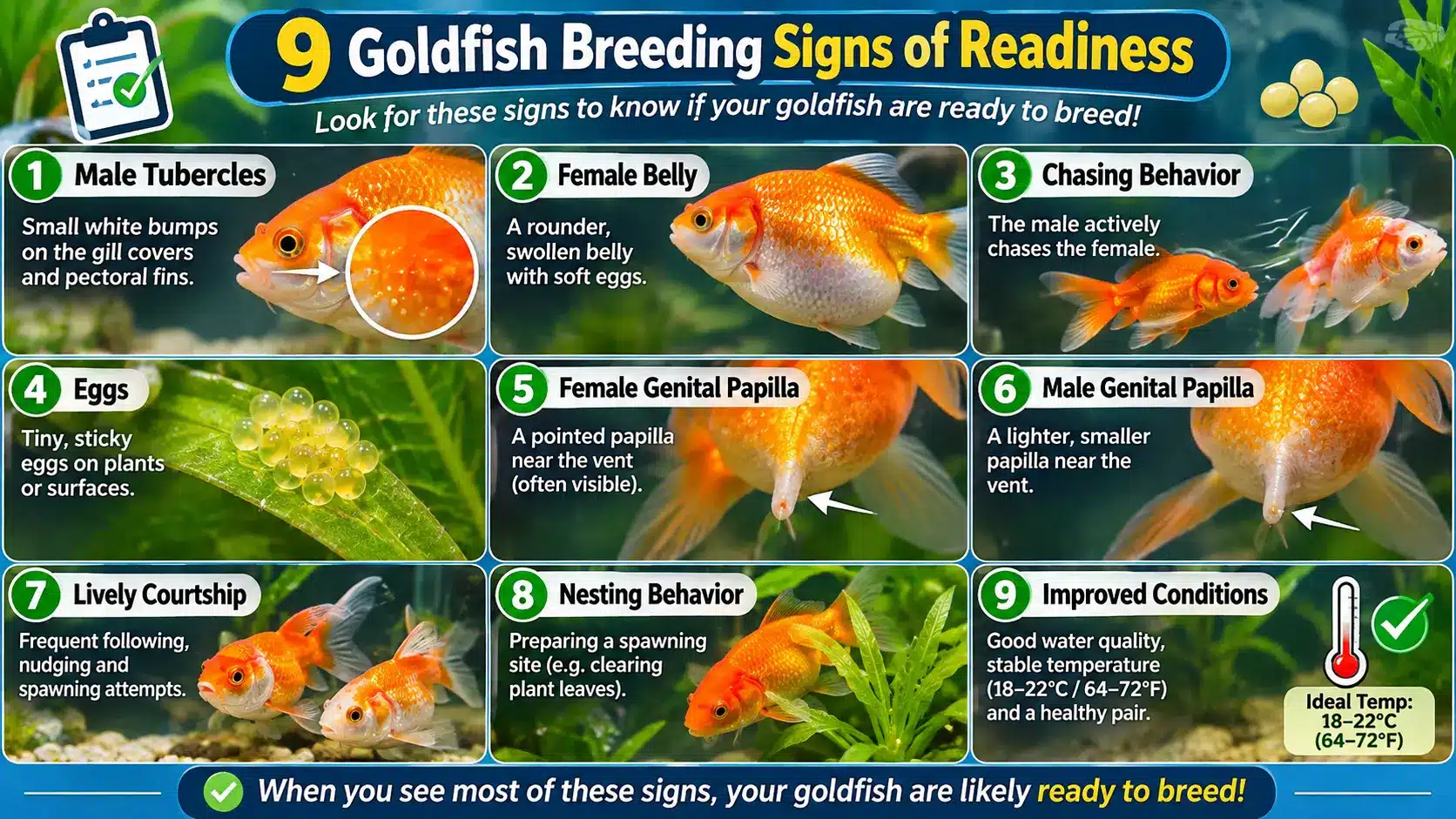
9 Warning Signs of Pregnancy in Goldfish
1. A Noticeably Goldfish Swollen Belly – A female goldfish may develop a fuller, rounder abdomen as her ovaries mature and eggs develop. However, sudden or uneven swelling can also indicate bloating, constipation, or dropsy.
2. A Plumper Body Shape – Goldfish carrying mature eggs may look heavier around the abdomen, especially near the breeding season. Watch for gradual changes rather than assuming every increase in body size means pregnancy.
3. Changes in Swimming Behavior – A female carrying eggs may swim more slowly or spend more time resting. However, unusual lethargy, difficulty swimming, or loss of balance can signal a health problem.
4. Male Goldfish Chasing Her – Persistent chasing is one of the clearest signs of breeding activity. Male goldfish may follow females around the tank and gently nudge their abdomens to encourage them to release eggs.
5. A More Rounded Abdomen Near the Vent – As eggs mature, the female’s abdominal area may become fuller, particularly toward the rear. Compare her body shape over several days to identify gradual changes.
6. A Protruding Vent – A female ready to spawn may have a slightly swollen or rounded vent. This physical change can occur during breeding condition, although it is not reliable proof that she is carrying eggs.
7. Increased Hiding or Resting – Some females may seek quieter areas of the aquarium when they are carrying mature eggs or experiencing breeding-related stress. Hiding combined with loss of appetite or unusual swimming deserves closer attention.
8. Increased Interest From Other Goldfish – Male goldfish may become unusually attentive, following the female and gathering around her. This behavior often becomes more noticeable when spawning is approaching.
9. Eggs Appearing in the Aquarium – Finding small, round, translucent or pale-yellow eggs attached to aquarium plants, decorations, or other surfaces confirms that spawning has occurred. Goldfish are egg-layers, so they do not give birth to live babies.
Important Note: Goldfish do not become pregnant in the same way as mammals. Females develop eggs inside their bodies and release them during spawning, while males fertilize the eggs externally. A goldfish swollen belly alone does not confirm that a goldfish is carrying eggs. Watch for several breeding signs together and rule out common health problems such as constipation, bloating, and dropsy.
Male Goldfish Develop Small White Breeding Spots
One of the strongest physical signs of readiness is the appearance of male goldfish breeding spots. These tiny white bumps are called breeding tubercles, and they commonly develop on the gill covers and the leading edge of the pectoral fins during breeding condition.
What Are Breeding Tubercles?
A breeding tubercle is a small, raised, white bump that helps a male goldfish during natural spawning. They can feel slightly rough, like fine sandpaper, and they often fade after the breeding season ends.
These spots are normal. They are not a disease, and they do not mean your goldfish needs treatment. A healthy male in breeding condition may develop them clearly one year and show only a few the next.
Where Do Breeding Spots Appear?
Look closely at:
- The gill covers, also called the operculum.
- The front edge of each pectoral fin, the pair of fins just behind the gills.
- Sometimes the head or cheeks, although the gill covers and pectoral fins are the most common locations.
Breeding Tubercles vs. Ich
Many owners confuse goldfish breeding tubercles with ich, also called white spot disease. The difference is location and pattern: tubercles appear mainly on the gill covers and front fins in a fairly even pattern, while ich usually spreads as tiny white dots across the body, tail, and fins.
If the white spots cover the whole fish, your goldfish is rubbing against objects, breathing quickly, or acting unwell, treat it as a possible health problem rather than breeding behavior. Ich needs prompt attention because it can spread quickly in an aquarium.
Male Goldfish Start Chasing Female Goldfish
During the goldfish breeding season, males often chase females around the tank or pond. This is one of the most obvious signs goldfish are mating, especially when one or more slimmer fish repeatedly follow a rounder fish.
How to Recognize Spawning Behavior
Typical goldfish spawning behavior includes:
- A male swimming closely behind a female.
- Repeated chasing around plants, decorations, glass, or pond edges.
- The male nudging or bumping the female’s sides and belly.
- Fast, energetic swimming, often early in the morning.
- The female being guided toward plants or spawning material.
This behaviour helps induce the female to drop her eggs. After she releases sticky eggs, the male releases milt into the water to fertilize them.
Is Goldfish Chasing Normal or Aggressive?
A short, energetic chase is usually normal breeding behavior. However, constant chasing can cause stress, especially in a small aquarium, a crowded setup, or a tank with only one female and several eager males.
Separation is the best response if the female cannot rest, hides constantly, loses colour, has damaged fins, or seems exhausted. Give her a calm space with clean water, gentle filtration, and plenty of room to swim freely.
Female Goldfish Develop a Rounder, Fuller Belly
A female goldfish carrying eggs often looks rounder and fuller, particularly when you view her from above. Her belly may look slightly uneven or lopsided because eggs do not always develop evenly on both sides.
How to Tell If a Female Goldfish Is Carrying Eggs
Look for these changes:
- A noticeably rounder abdomen.
- A slightly protruding vent, the opening just in front of the anal fin.
- A body shape that appears deeper or plumper than usual.
- Slower movement or more time spent near plants and shelter.
A female may still lay eggs even if no male is present. Without a male to fertilize them, the eggs will not develop into fry.aquariacademy
How to Distinguish Eggs From Bloating or Illness
Egg development usually comes with breeding behaviour: males chasing, nudging, and showing breeding tubercles. Bloating or illness is more concerning when the fish looks swollen all over, floats oddly, struggles to swim, stops eating, or shows clamped fins.
Do not squeeze a goldfish to check for eggs. Squeezing can injure the fish and cause serious stress. Instead, observe her body shape, behaviour, water temperature, and the presence of males before assuming she is ready to spawn.
Goldfish Become More Active During Breeding Season
Many goldies become noticeably more active as conditions warm. They may swim faster, splash near the surface, explore plants, and gather near the shallowest or warmest part of an outdoor pond.
This burst of energy often happens in the early morning. In an indoor aquarium, a gradual increase in water temperature and longer daylight can encourage the same response.
Activity alone does not prove that spawning is about to happen. Combine it with the other physical signs of readiness, especially breeding spots on males and a fuller belly on females.
Male Goldfish Nudge the Female’s Belly and Vent
A ready male will often push his nose or body against the female’s belly and vent area. This nudging is part of goldfish mating signs and helps encourage her to release eggs.
The male may also press the female toward plants, a spawning mop, or the side of the tank. This is not always gentle, but it is a normal part of the mating process when both fish are healthy and have enough space.
If the chasing becomes nonstop, move the female to a separate tank or add more hiding places. A breeder should always put fish welfare ahead of producing a spawn.
Female Goldfish Begin Looking for Places to Lay Eggs
Before goldfish laying eggs begins, a female may spend more time around plants, roots, fine-leaved vegetation, and other textured surfaces. Goldfish prefer places where their sticky eggs can attach and stay safe.
For an indoor setup, add a spawning mop, java moss, hornwort, or fine artificial plants. For an outdoor pond, dense plants naturally give eggs a place to cling.
A sponge filter can be useful in a fry tank because it provides gentle filtration without pulling in eggs or newly hatched fry. Avoid strong pump flow during spawning and early fry development.
Suggested image: A labelled aquarium setup showing a spawning mop, live plants, sponge filter, and a separate fry tank.
Goldfish Eggs Appear on Plants, Glass, and Decorations
Once a female releases eggs, you may see tiny clear, pale yellow, or amber dots stuck to plants, glass, filter intake areas, decorations, and spawning mops. Goldfish scatter eggs rather than laying them in one neat cluster.
What Do Fertilized Goldfish Eggs Look Like?
Fertilized eggs are usually small, round, and slightly sticky. At suitable water temperature, they can hatch in about three to seven days, though warmer water generally speeds development.
At around 20°C, eggs may hatch in roughly four days. Cooler water slows the process, while very warm water can increase the risk of poor water quality and fungal problems.
How to Tell Fertilized Eggs From Unfertilized Eggs
Fertilized eggs often develop a small dark spot or change colour as the embryo grows. Unfertilized eggs may stay clear, turn white, or develop fuzzy fungus.
Remove obviously dead or fungus-covered eggs carefully if you are raising fry. Keep the hatching container well aerated, but avoid a powerful filter that can trap or damage eggs.
How to Tell If Your Goldfish Have Finished Spawning
Successful spawning usually ends when the chasing slows, the female stops releasing eggs, and the fish return to normal swimming and feeding. A single female can release hundreds or even thousands of eggs during one spawning event.
Do not remove adults too quickly. Some fish rest briefly and may begin another round of spawning later the same morning. Once the activity has clearly ceased, move the adults or transfer the egg-covered spawning material to a safer container.
Adult goldfish will eat eggs and fry if they get the chance. Removing the parents, or moving the eggs, is the simplest way to protect the eggs.
What to Do When You Notice Goldfish Breeding Signs
When you notice goldfish breeding signs, prepare before the eggs appear. A simple breeding setup with plants or a spawning mop, clean water, gentle filtration, and enough surface area gives your fish the best chance of a successful spawning.
Breeding goldfish can be difficult to breed consistently in small fish bowls or crowded aquariums. Goldfish for breeding need stable water quality, good nutrition, and enough space for males and females to interact without constant stress.
How to Protect Goldfish Eggs From Being Eaten
Use one of these methods:
- Move the spawning mop or egg-covered plants to a separate hatching tank.
- Move the adult goldfish back to their main aquarium after spawning.
- Add dense plants or a spawning mop so eggs have somewhere to attach.
- Use a sponge filter in the fry tank to prevent eggs and fry from being pulled into the filter.
How to Care for Goldfish After Spawning
After spawning, do a partial water change if needed and keep the temperature stable. Feed adults a varied, high-quality diet, but remove uneaten food promptly so it does not pollute the water.
Newly hatched fry first live off their yolk sacs. Once they swim freely and begin searching for food, offer newly hatched brine shrimp, infusoria, or a suitable powdered fry food in very small amounts.
When to Separate Male and Female Goldfish
Separate them when the female appears exhausted, injured, or unable to escape the males. Separation is also wise if you do not want a large number of fry, because goldfish can produce far more young than most hobbyists can responsibly raise.
A serious breeder may cull weak or poorly formed fry to maintain the quality of a particular variety, especially with fancy goldfish. Beginners should focus first on healthy adults, clean water, and responsible rehoming rather than trying to raise every egg.
FAQs
How to tell if goldfish are pregnant?
Goldfish are not truly pregnant; females carry eggs and then lay them. A rounder belly, a slightly protruding vent, slower movement, and males chasing her are common signs that spawning may be near.
How old do goldfish need to be to breed?
Most goldfish need to be at least one year old before they reliably lay eggs. Good body condition, adult size, and seasonal temperature changes matter more than age alone.
How do goldfish mate?
A male chases and nudges a female, encouraging her to release eggs. As she drops sticky eggs onto plants or other surfaces, the male releases milt to fertilize them in the water.
Do goldfish lay eggs without a male?
Yes. A female can release eggs without a male, but the eggs will not be fertilized and will not hatch into fry. aquariacademy
Can goldfish breed in a tank?
Yes. Goldfish can breed indoors when water temperature, lighting, nutrition, and tank conditions resemble their natural spring breeding season. A spawning mop or fine plants makes egg collection much easier.
Why does my male goldfish have white spots?
White spots on the gill covers and pectoral fins are often breeding tubercles. If the spots spread over the whole body, fins, and tail, or the fish seems unwell, consider ich or another health issue instead.
Which month do goldfish lay eggs?
Goldfish commonly breed in the spring, often from March to June, when warmer water triggers spawning. Indoors, the exact month matters less than stable temp, good fertility, and a healthy hobby setup.
How can you tell if a goldfish has laid eggs?
Look for tiny clear or pale sticky eggs on plants, glass, and decorations. Remove adults quickly, because eggs can get eaten. Ideally, move spawning material to a separate fry tank.
How many times a year do goldfish lay eggs?
Healthy goldfish may spawn several times during the breeding season, often every few weeks. Fertility varies with age, condition, water quality, and temp, so a hobby breeder should not expect the same result every time.
Can goldfish breed in a pond?
Yes. Goldfish naturally breed in the spring in an outdoor pond, especially when water becomes warmer and plants provide safe places for eggs. Eggs may get eaten by adults or other pond life, so dense plants help.
What are the signs that goldfish are breeding?
Males develop white breeding tubercles and chase females, while females look fuller in the belly. Increased early-morning activity, nudging, and sticky eggs on plants are clear signs that spawning is happening.
How can you tell if a goldfish is male or female?
Males often have breeding tubercles on the gill covers and pectoral fins, plus a slimmer body. Females usually look rounder, especially when carrying eggs. Ideally, use several signs together rather than relying on one feature.
At what age do goldfish become sexually mature?
Most goldfish become sexually mature at about one year old, though size and condition matter too. Good nutrition, stable water quality, and a suitable temp support fertility and successful breeding in the spring.
How can you encourage goldfish to spawn?
Gradually raise the temp, improve diet, add plants or a spawning mop, and provide clean water. A small water change can mimic spring conditions and help induce natural spawning; do not squeeze or stress the fish.
How long does it take for goldfish eggs to hatch?
Goldfish eggs usually hatch in about three to seven days, depending on water temp and conditions. Ideally, keep eggs in a calm, well-aerated fry tank so they do not get eaten or damaged by strong filtration.
Conclusion
Recognizing pregnant goldfish signs early gives you time to prepare a safe setup, protect the eggs, and keep stress low. Watch for breeding tubercles on males, a fuller belly on females, chasing and nudging, increased activity, and finally sticky eggs attached to plants, glass, or a spawning mop. These signs together show that your goldfish are ready to spawn, not simply that one fish is sick or bloated.
Goldfish breeding can be exciting, but it also brings responsibility. Adults may eat their own eggs and fry, so remove the parents or transfer the eggs once spawning ends. Keep the water clean, use gentle filtration, feed appropriately, and give fry a safe tank with room to grow. Whether you keep goldfish in an indoor aquarium or an outdoor pond, understanding these natural signs helps you support a healthy breeding season and raise strong, well-cared-for young fish.
You might also like
- How Many Babies Do Goldfish Have? Beginner’s Guide (FAQ)
- How Long Are Goldfish Pregnant FOR? (How to tell if my goldfish is pregnant & What to Do!)
- 50+ Lovable Gold Fish Names: (Best Goldfish Names Ever)
- Goldfish with Big Eyes: The Only Guide You’ll Ever Need