How many goldfish per gallon of water can you safely keep in your aquarium? As a general recommendation, one fancy goldfish needs at least 30–40 gallons of water, while one common or comet goldfish needs around 55–75 gallons.
Add another 10–20 gallons or more for each additional fish, depending on its variety, adult size, and filtration needs. These guidelines prioritize long-term health rather than the outdated one-inch-per-gallon rule.
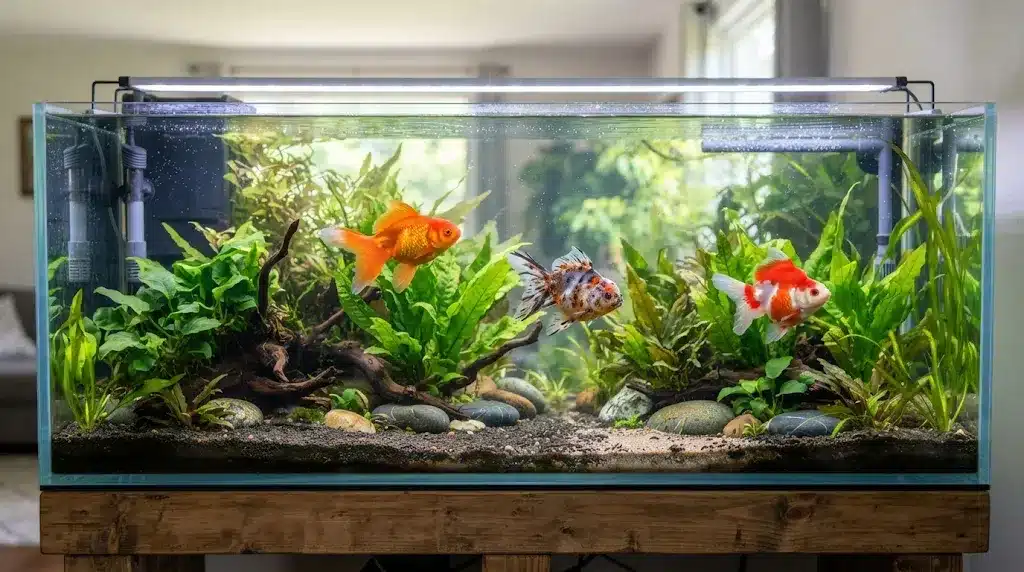
Although goldfish look small and peaceful in pet stores, they produce significant waste and need plenty of swimming space to stay healthy. Choosing the right tank size from the beginning can prevent poor water quality, stunted growth, and unnecessary stress.
So, is a 10-gallon or 20-gallon aquarium ever suitable for goldfish? What tank size should you choose for two, three, or even five goldfish?
Let’s explore expert-backed goldfish care recommendations, including guidance from aquatic veterinarians and experienced fishkeeping organizations, to help you calculate the right aquarium size and create a healthy environment for your fish.
How Many Goldfish Per Gallon of Water?
How much room do goldfish need? Do not use a simple fish per gallon number for goldfish. Goldfish produce more waste than many tropical fish, grow larger than most buyers expect, and need open swimming space rather than a crowded vertical tank.
As a rule of thumb, many keepers use 20 US gallons for one goldfish, then add 10 gallons for each additional fish. That can work as a starting point for smaller fancy goldfish, but it is not an absolute promise for every fish.
| Tank capacity | Practical stocking starting point | Important note |
|---|---|---|
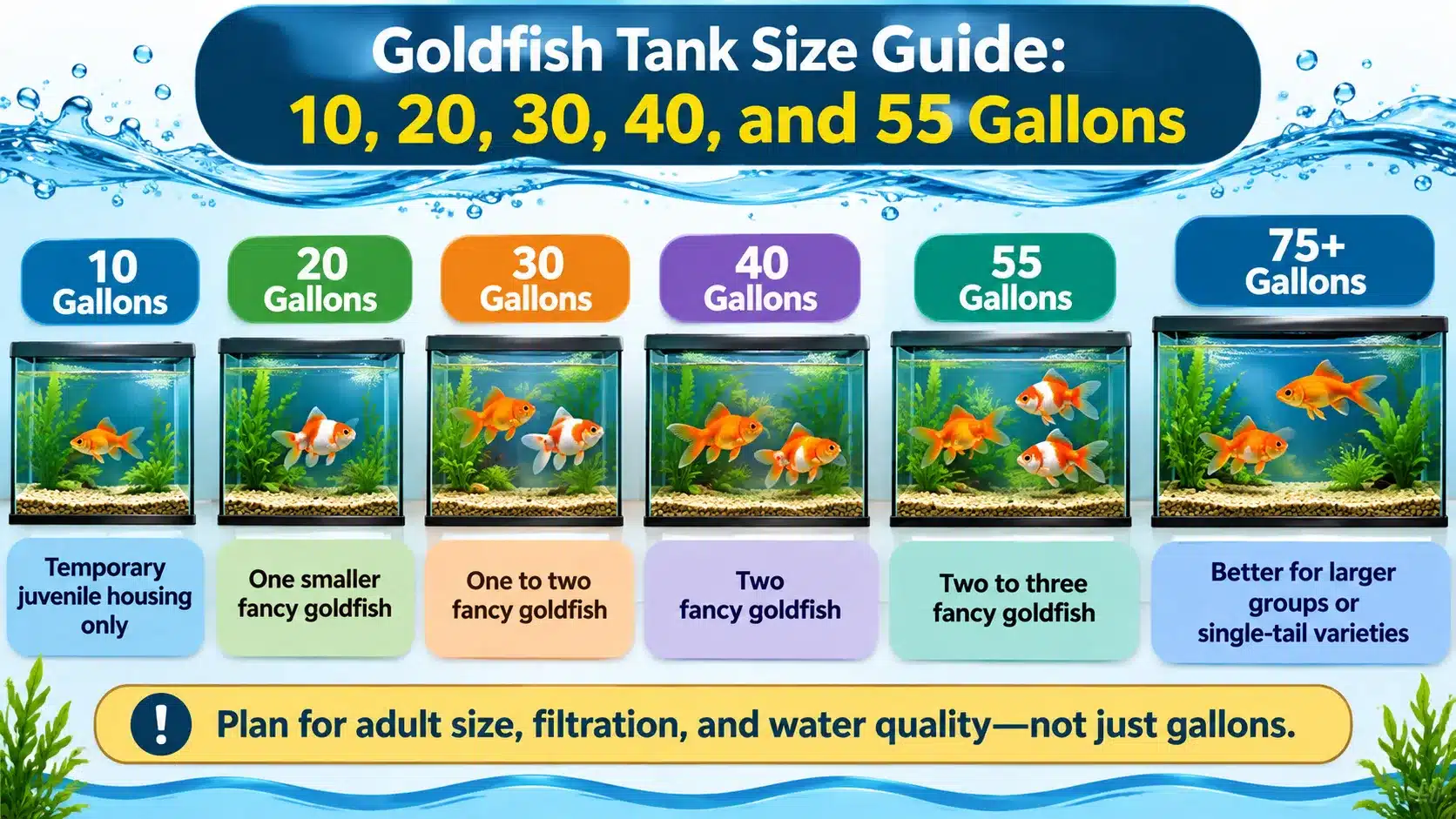
| 10 gallon tank | Short-term juvenile housing only | Not a permanent adult home; fish will quickly outgrow it. |
| 20 gallon tank | One small fancy goldfish, at most | Use strong filtration and upgrade as it grows. |
| 30 gallon tank | One or two fancy goldfish | A 30 gallon tank gives more stable water conditions. |
| 40 gallon tank | Two fancy goldfish, or one larger single-tail goldfish | Choose a long, wide aquarium rather than a tall one. |
| 55 gallon tank | Two to three fancy goldfish | Better swimming room and easier water-quality management. |
| 75 gallon tank | Three to four fancy goldfish, depending on adult size | A better long-term choice for several fish. |
| 100 gallon | Larger groups or common goldfish | Common varieties need substantial length and volume. |
These numbers are not a license to fill a tank immediately. Treat them as a planning framework, then adjust for the fish’s adult size, filter capacity, feeding, and test results.
Why the One-Inch-Per-Gallon Rule Doesn’t Work for Goldfish
The old “one inch of fish per gallon” rule does not work well for goldfish. It ignores the fact that goldfish produce a lot of waste, grow quickly, and need horizontal room to swim—not just enough water to cover their body length.
A one-inch juvenile goldfish may fit the inch-per-gallon calculation, but that same fish can become a much larger adult. If you buy based on its current size, you may need a bigger tank within months.
The per gallon rule also overlooks filtration. Goldfish produce more waste than many smaller fish, so a tank can have enough water volume yet still develop ammonia, nitrite, and nitrate problems if the filter and maintenance routine cannot keep up.
How Much Tank Space Does One Goldfish Need?
How much room do goldfish need? At minimum, plan for a spacious, filtered aquarium—not a bowl. The RSPCA advises at least 50 litres, or about 13 US gallons, and stresses that larger tanks are better because they hold more stable water conditions.
For a practical long-term setup, many aquarists aim for 20 gallons for one smaller fancy goldfish, with 10 gallons for each additional fish. For common or single-tail varieties, plan for substantially more space because they are active swimmers and can reach a much larger adult size.
The RSPCA also recommends tank dimensions based on the fish’s expected adult body length: at least four times its adult length in tank length, twice its length in width, and three times its length in height. That makes tank shape just as important as total gallons of water.
Goldfish Tank Size Guide: How Many Goldfish in Different Tank Sizes?
The best goldfish aquarium size depends on whether you keep fancy varieties or active single-tail fish. Use the guide below as a starting point, then let adult size, filtration, and water testing guide your final decision.
How Many Goldfish in a 10-Gallon Tank?
A 10 gallon tank is not a suitable permanent home for an adult goldfish. It may temporarily hold a very small juvenile goldfish, but the fish will outgrow it quickly, and waste can build up fast in a small tank.
Avoid keeping multiple goldfish in 10 gallons. If you already have a 10 gallon aquarium, plan an upgrade before adding a fish rather than relying on frequent water changes to compensate for limited space.
How Many Goldfish in a 20-Gallon Tank?
A 20 gallon tank can suit one smaller fancy goldfish as a starting point, provided the filter is appropriately sized and the fish has open swimming space. It is not ideal for a comet goldfish, shubunkin, or other fast single-tail variety.
Do not add a second fish simply because the tank looks empty. Goldfish grow, and additional fish increase waste, competition, and the chance of poor water quality.
How Many Goldfish in a 30-Gallon Tank?
A 30 gallon tank is a more comfortable starting point for one or two fancy goldfish, especially if they are young and you plan to monitor growth carefully. A long, wide 30 gallon aquarium gives them more useful swimming space than a tall, narrow tank.
For two fish, use an oversized filter, feed carefully, and test the water regularly. If nitrate rises quickly or the fish seem stressed, upgrade rather than adding more fish.
How Many Goldfish in a 40-Gallon Tank?
A 40 gallon tank can house two fancy goldfish with more room to grow, or one larger single-tail goldfish with better swimming space. It is a sensible middle-ground goldfish tank size for keepers who want a more stable aquarium.
Keep the tank long rather than tall. Goldfish swim horizontally, so floor space matters more than height.
How Many Goldfish in a 55-Gallon Tank?
A 55 gallon tank is a strong long-term option for two to three fancy goldfish, depending on their eventual adult size. It provides more stable water conditions and gives you a better margin for error with feeding and maintenance.
For common goldfish, treat 55 gallons as a starting point rather than a final destination. These fish need length, strong filtration, and often a larger tank as they mature. chewy
Common Goldfish vs. Fancy Goldfish: Do They Need Different Tank Sizes?
Yes. Common goldfish, including comet goldfish and shubunkins, are streamlined, fast swimmers that often reach 6 to 10 inches or more. They need a long aquarium with plenty of open space and powerful filtration.
Fancy goldfish, such as orandas, fantails, ranchus, and black moors, usually stay somewhat smaller, often around 6 to 8 inches. Their rounded bodies and flowing fins still need room, but they generally do better in gentler water flow than fast single-tail varieties.
| Type of goldfish | Adult size trend | Best tank approach |
|---|---|---|
| Common goldfish | Often larger and very active | Long, wide aquarium; substantial filtration; avoid small tanks. |
| Comet goldfish | Large, fast, active swimmer | Best suited to a large tank or pond-style setup. |
| Fancy goldfish | Often smaller but still needs space | Wide tank, moderate flow, careful feeding, and strong filtration. |
| Orandas and other fancy types | Rounded body, flowing fins | Avoid strong currents; provide open swimming areas. |
Do not mix very different body types casually. A fast comet can outcompete a slower fancy fish for food, and a strong current can make swimming difficult for fancy varieties.
What Happens When You Keep Too Many Goldfish in One Tank?
Overstocking is one of the main causes of goldfish illness. Too many fish in a tank can lead to chronic stress, poor water quality, low oxygen, aggression over food, and faster waste buildup.
Goldfish produce a lot of waste, and that waste breaks down into ammonia. In a healthy aquarium, beneficial bacteria convert ammonia to nitrite and then nitrate, but an overloaded tank can overwhelm that biological process.
Signs that your stocking level may be too high include:
- Ammonia or nitrite readings above safe levels.
- Frequent algae growth or cloudy aquarium water.
- Fish gasping near the surface.
- Rapid nitrate buildup between water changes.
- Stunted growth, lethargy, clamped fins, or repeated illness.
A larger tank gives you more stable water conditions and makes mistakes less dangerous. A smaller tank changes quickly, so it leaves less room for error.
How Filtration and Water Quality Affect Goldfish Stocking Levels
Filtration is not optional for goldfish. Because goldfish produce more waste than many other aquarium fish, use a filter rated for at least five to ten times the tank volume per hour, and make sure it provides both mechanical and biological filtration.
Good water quality is essential. Test for ammonia, nitrite, and nitrate; the RSPCA lists ideal targets of ammonia below 0.1 ppm, nitrite below 0.2 ppm, and nitrate below 50 ppm.
A strong filter does not replace water changes. Perform regular partial water changes—often 10 to 25 percent weekly—and gravel-clean waste from the substrate. Use a dechlorinator when adding tap water, because untreated tap water can contain chlorine or chloramine that harms fish.
A planted tank can improve the look of an aquarium and offer enrichment, but plants alone will not remove enough waste to make overcrowding safe. Plants are helpful support, not a replacement for filtration and water changes.
How to Calculate the Right Number of Goldfish for Your Aquarium
Use this simple process before buying additional fish:
- Identify the type of goldfish and research its likely adult size.
- Choose a long, wide sized tank rather than a tall bowl or narrow aquarium.
- Start with 20 gallons for one smaller fancy goldfish, then add 10 gallons for each additional fish as a baseline.
- Increase the plan for common, comet, or other single-tail goldfish because they need more swimming room.
- Select filtration rated for the tank’s full capacity, ideally with extra capacity for goldfish waste.
- Cycle the aquarium before adding fish, then test water parameters regularly.
- Add fish slowly and stop if nitrate rises too quickly or water quality becomes difficult to maintain.
For example, if you want three fancy goldfish, a 50 gallon tank is a more realistic starting point than a 20 gallon aquarium. If you want common goldfish, plan for an even larger tank because they grow larger and swim more actively.
Can You Keep Two or More Goldfish Together?
Yes—goldfish are social fish and can live well in pairs or small groups when the aquarium is large enough. The key is not simply “how many goldfish should be kept together,” but whether the tank can support their adult size and waste load.
Keep similar-sized fish together when possible. A large goldfish may outcompete a smaller fish for food, and a fast single-tail goldfish may leave a slower fancy goldfish behind during feeding.
Choose tank mates carefully. Goldfish are generally peaceful, but they should not be housed with fish small enough to fit in their mouths. Tropical fish also may not share the same preferred temperature range, so research compatibility before mixing species. rspca.org
Tips for Choosing the Right Goldfish Tank Size for Long-Term Health
- Buy for the adult size, not the size of the juvenile goldfish at the store.
- Choose a long, wide fish tank rather than a tall, narrow one; goldfish need horizontal swimming space.
- Avoid bowls, jars, and tiny decorative tanks. They do not provide enough stable water volume, filtration, or oxygen exchange.
- Install a filter with capacity above the tank’s stated volume, especially for multiple goldfish.
- Add an air stone or ensure the filter disturbs the surface to improve oxygen exchange.
- Feed measured portions and remove uneaten food; overfeeding increases waste and worsens water quality.
- Test water weekly, especially in a newer aquarium or after adding fish.
- Do regular percent water changes, such as 10 to 25 percent weekly, while vacuuming debris from the gravel.
- If your fish are growing quickly or water quality is hard to maintain, get a bigger tank rather than adding more fish.
FAQs
How many goldfish can I keep in a 20 gallon tank?
For long-term housing, keep one smaller fancy goldfish at most in a 20 gallon tank. Use strong filtration, monitor water quality, and upgrade if the fish grows beyond the available space.
Can a goldfish live in a 10 gallon tank?
Not permanently. A 10 gallon aquarium may temporarily hold a tiny juvenile, but goldfish grow quickly and need a larger, filtered home as adults.
How many gallons does a goldfish need?
A practical baseline is 20 gallons for one smaller fancy goldfish, with 10 gallons for each additional fish. Common and comet goldfish need more space because they grow larger and swim actively.
How many goldfish should be kept together?
Two or three similar-sized fancy goldfish can work in a 50 to 55 gallon aquarium if filtration and maintenance are strong. For common goldfish, plan for a larger tank because of their adult size and activity level.
Do goldfish need a heater?
Usually, no. Goldfish generally do well in cool, stable water; the RSPCA notes a range of about 10 to 21°C, while other care guidance commonly cites 65 to 75°F for home aquariums. Avoid sudden temperature swings.
Can I keep goldfish with tropical fish?
Sometimes, but it is not automatically a good match. Goldfish prefer cooler water, while many tropical fish need warmer temperatures; also make sure any tank mates are too large to be eaten and will not harass the goldfish.
Do goldfish grow to the size of their tank?
No. Goldfish do not simply stop growing because they live in a small tank. Restricted space and poor water conditions can harm their health and development, while a properly sized aquarium supports normal goldfish growth.
Are feeder goldfish good pets?
Feeder goldfish are often common varieties sold as food for larger animals. They can live long lives as pets, but they need the same space, filtration, and care as any other goldfish.
Can I keep 2 goldfish in a 5-gallon tank?
No. A 5-gallon tank is far below the absolute minimum tank size for even one adult goldfish. Two goldfish need much more space, strong filtration, and regular water changes.
Can I keep 2 goldfish in a 1-gallon tank?
No. A 1-gallon tank cannot safely support two goldfish. Goldfish produce a lot of waste and need a larger, filtered aquarium with stable water conditions.
What tank size is best for goldfish?
A long, wide 20-gallon tank is a good starting point for the first fish, especially a smaller fancy goldfish. Add about 10 gallons per extra gold fish, and choose more space for a single tail goldfish.
Can goldfish live in a bowl or a small tank?
No. Bowls and very small tanks do not provide enough stable water volume, oxygen, filtration, or swimming room. A filtered aquarium is much safer and healthier for goldfish.
Does tank shape affect how many goldfish it can hold?
Yes. A long, wide tank provides more useful swimming space than a tall, narrow one. Goldfish swim horizontally, so tank length and floor area matter as much as total gallons.
What water conditions and filtration do goldfish need?
Keep ammonia and nitrite at zero, keep nitrate low, and use a filter rated for the tank size. Do regular partial water changes and treat tap water with a dechlorinator. A 50-litre tank is a useful minimum benchmark for one goldfish.
How can I tell if my goldfish needs a bigger tank?
Upgrade if your goldfish looks crowded, grows quickly, gasps at the surface, or water quality becomes hard to maintain. Frequent algae, high nitrate, and stress signs also show that the tank is too small.
Is a 10-gallon tank enough for 3 goldfish?
No. Three goldfish need far more space than a 10-gallon tank can provide. Use a larger, filtered aquarium and plan around their adult size.
Can I keep 3 goldfish in a 20-gallon tank?
Not long term. A 20-gallon tank may suit one smaller fancy goldfish, but three need a much bigger tank, stronger filtration, and regular water changes.
Conclusion
When people ask How Many Goldfish Per Gallon tank, the best answer is not a single number. Goldfish need space based on their adult size, variety, swimming behavior, filtration, and water quality. A small fancy goldfish may begin in a 20 gallon aquarium, while a comet or other single-tail goldfish needs a much larger, long tank.
Use 20 gallons for one smaller fancy goldfish and 10 gallons for each additional fish only as a starting framework. Watch nitrate, ammonia, and nitrite, perform regular water changes, and upgrade before the fish become crowded. A larger tank is easier to keep stable, gives goldfish room to swim, and supports healthier long-term growth.
Choose the biggest practical aquarium you can maintain, avoid bowls and overcrowded tanks, and plan for the fish your goldfish will become—not the tiny fish you bring home. That approach gives your goldfish the best chance to live comfortably for years.
You might also like
- How Big Do Goldfish Get: Goldfish Myths & Facts (Debunked)
- Pregnancy in Goldfish: 7 Signs to Look for & (What To Do)
- What Fish Can You Put with Goldfish? (15 Ideal Tankmates)
- Goldfish with Big Eyes: The Only Guide You’ll Ever Need
- What Algae Eaters Can Live with Goldfish? (5 Best Tankmates)
- Will Goldfish Mate in a Tank? Step-By-Step (Breeding Guide)
- How Many Goldfish to a 10 Gallon Tank? (Exact Numbers Solved)
- Can Goldfish Survive with Tropical Fish: the 5 Harsh Realities!
- How Long Can a Goldfish Survive in a Plastic Bag: 5 Transportation Tips
- How Many Goldfish in a 5 Gallons Tank: (The Golden Rule)
- Minimum Size Tank for Goldfish 101: (Don’t Make This Mistake)
- How Many Goldfish Should Be Kept Together: (Solved)
- Ranchu Goldfish Care 101: Everything You Should Know (FAQ)
- How Big Do Ranchu Goldfish Get: 7 Tips for the Perfect Size!
- How Long Will Ranchu Goldfish Live: Mind-Blowing Lifespan!
- Where to Buy Ranchu Goldfish: (Don’t Make This Mistake!)
- How Much Are Lionhead Goldfish? (Revealing the Exact Cost!)
- How Old Do Goldfish Live: 5 Tips for pond fish Care!