Angelfish sexing can be tricky, even for experienced aquarium owners. Do you know how to tell a male angelfish from a female? Although both sexes look nearly identical, differences in their body shape, forehead profile, and breeding tubes can help you identify them.
The most reliable way to sex angelfish is to examine their breeding tubes when they prepare to spawn. Females develop a wider, blunt ovipositor, while males show a narrower, pointed breeding tube. Their body shape and head profile can offer extra clues, but these features alone cannot confirm their sex.
Whether you plan to breed angelfish or simply want to understand your aquarium fish better, learning these differences will save you from common identification mistakes. We’ll explain the physical signs, breeding behavior, and practical methods that help distinguish males from females. Let’s dive in and learn how to sex your angelfish with greater confidence!
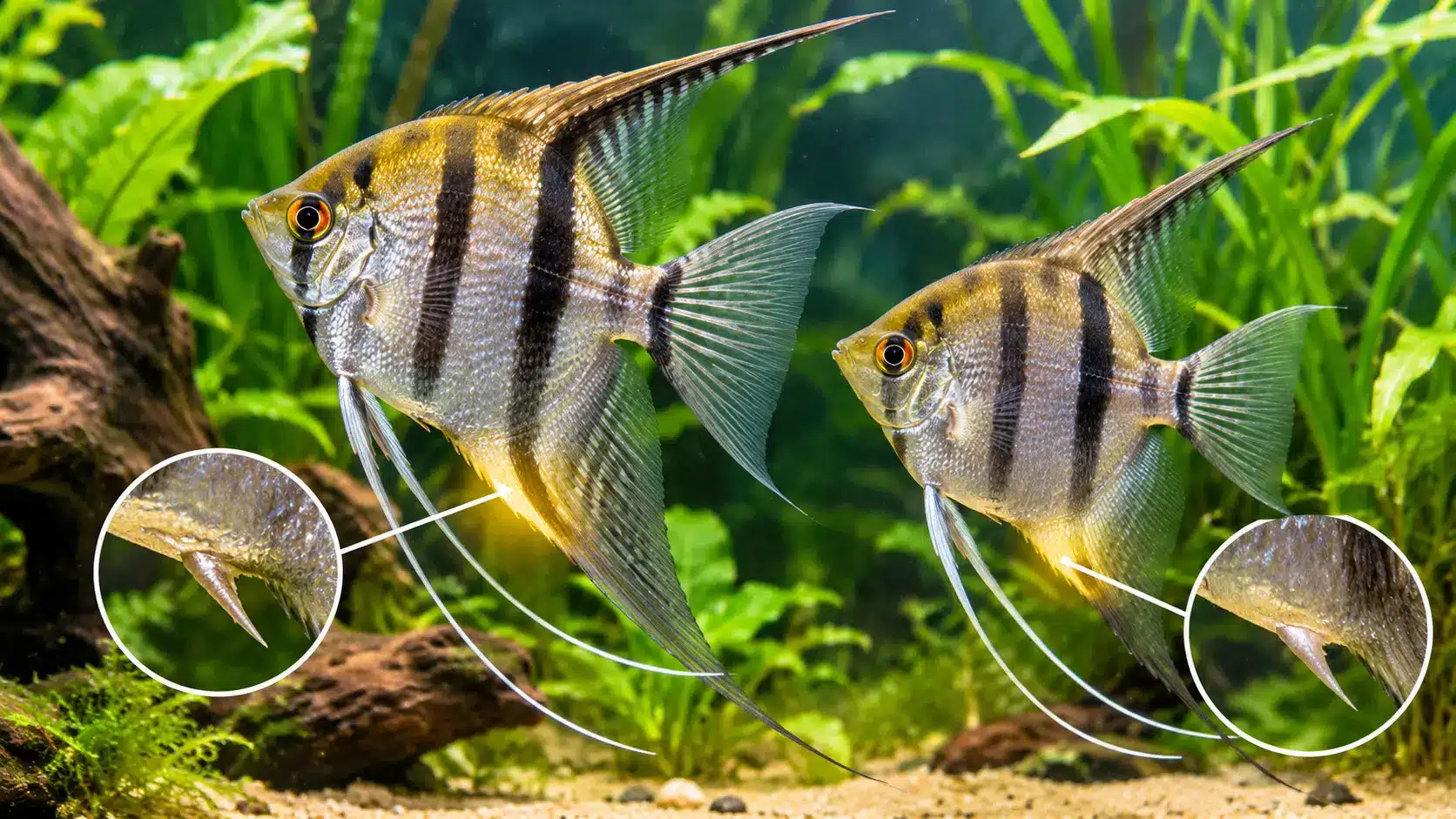
What Is Angelfish Sexing and Why Does It Matter?
Angelfish sexing means identifying whether an angelfish is male or female. It matters most if you want to breed angelfish, raise fry, or avoid keeping two same-sex fish that appear to be a pair but never produce eggs.
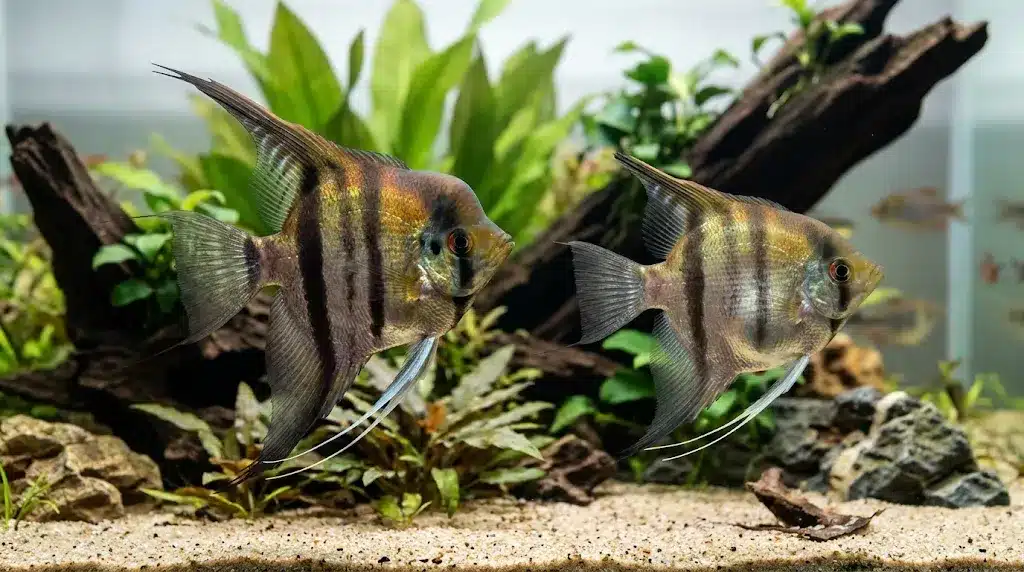
Freshwater angelfish (Pterophyllum scalare) show very little obvious sexual dimorphism. Unlike guppies or bettas, a male angelfish and female angelfish can look nearly the same in a community tank, especially when they are young.
Sexing angel fish becomes easier once the fish mature and begin pairing. Even then, the strongest evidence appears when an angelfish pair prepares a spawning site, the female starts laying eggs, and the male follows behind to fertilize the eggs.
How to Tell Male and Female Angelfish Apart
To tell the difference between male and female angelfish, use a combination of clues rather than one feature. The breeding tube is the best indicator, but pairing behavior, body condition, and spawning role add useful confirmation.
The reliable method: breeding tubes
During spawning condition, both sexes develop a genital papilla, also called a breeding tube. It appears between the ventral fin and anal fin on the underside of the fish.
| Feature | Male angelfish | Female angelfish |
|---|---|---|
| Breeding tube | Narrow, small, and pointed | Broader, larger, blunt, and rounded |
| Papilla appearance | Often looks like a tiny pointed tube | Looks thicker and more prominent |
| Spawning role | Follows the female and fertilizes the eggs | Deposits eggs on the spawning site |
| Body shape | May look more angular, but not reliable | May look rounder when full of eggs, but not reliable |
| Head shape | Some males develop a nuchal hump, but many do not | Some females can also show a head bump |
The female’s breeding tube is designed to release eggs, so it is wider and blunter. The male’s papilla is smaller and more pointed because he releases milt to fertilize the eggs after the female lays them.
Use several signs together
A good angelfish male or female identification process looks like this:
- Watch for a bonded angelfish pair that cleans the same surface.
- Look for a visible breeding tube shortly before spawning.
- Identify which fish deposits eggs.
- Confirm that the other fish follows and fertilizes the eggs.
- Record the result so you can identify the sexes confidently in future spawns.
If one fish lays eggs, you know for certain that one is a female. If the other fertilizes the eggs, you know that one is a male.
Male vs. Female Angelfish: Key Physical Differences
Male vs. female angelfish differences are subtle. Many guides overstate forehead bumps, fin length, and body shape, but these traits overlap too much to provide a dependable answer.
| Physical clue | How useful is it? | What to watch for |
|---|---|---|
| Breeding tube | Highly useful during spawning | Female: broad and blunt; male: narrow and pointed |
| Body profile | Low reliability | A female carrying eggs may look rounder, but body shape varies by individual |
| Nuchal hump | Low to moderate reliability | Some mature males develop a bump above the eyes, but females can show one too |
| Fin shape | Low reliability | Long fins, veil tails, and fin damage are not dependable sex indicators |
| Size | Low reliability | Males may average slightly larger, but tank conditions and genetics matter more |
| Egg-laying | Definitive | The fish that lays eggs is female |
A mature male angelfish may develop a small nuchal hump, but it is not a dependable sexing feature. Some males never develop one, while some females develop a similar-looking bump.
What the breeding tube looks like
Think of the female’s ovipositor as a short, rounded tube, similar to the eraser end of a pencil. The male’s papilla is more like a sharpened pencil tip: thinner, smaller, and pointed.
This difference is easiest to see when the fish are ready to spawn. Outside that window, the papilla may be retracted and nearly impossible to see.
How to Identify Angelfish by Their Breeding Tubes
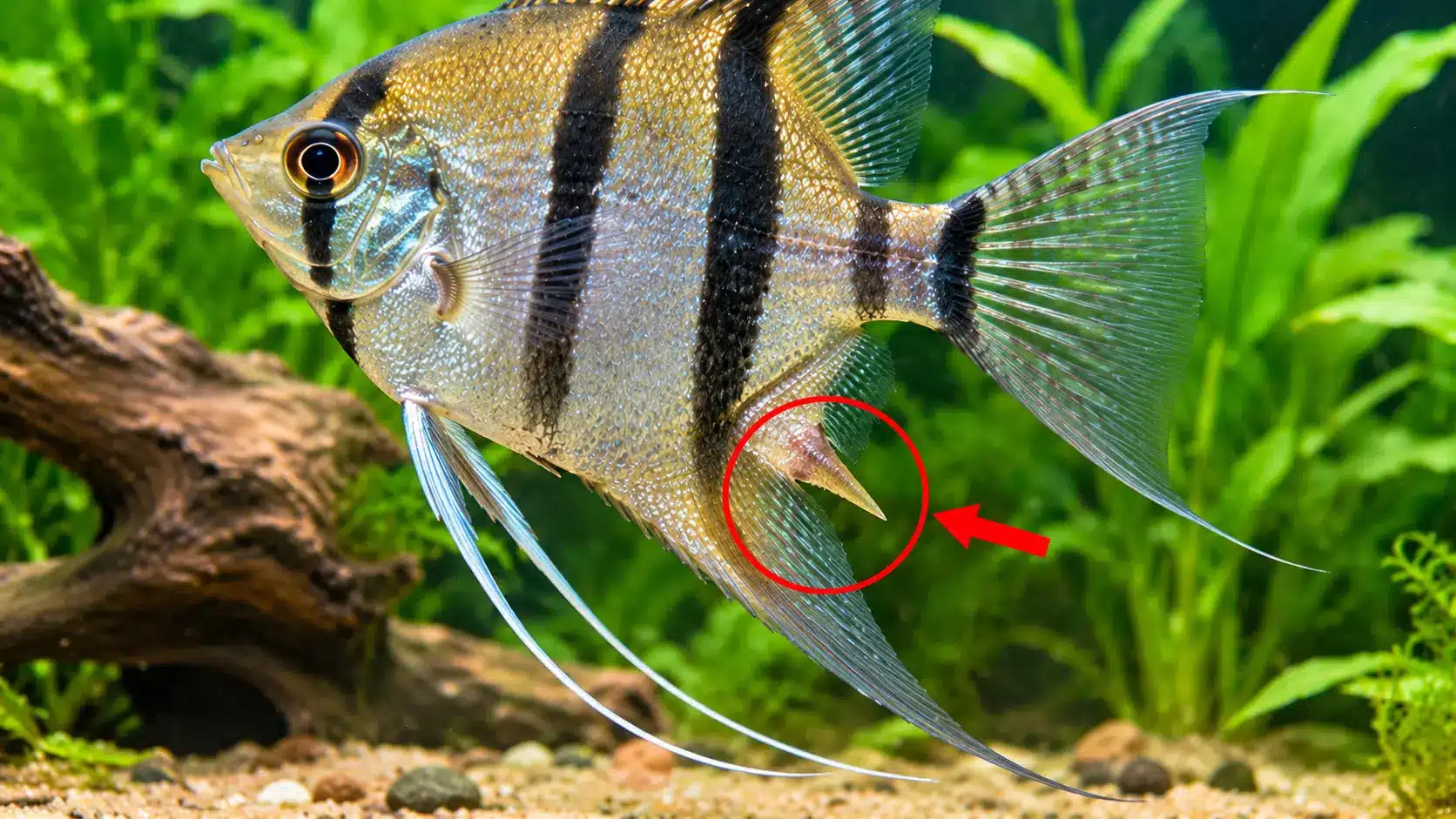
The angelfish breeding tube is the most practical visual clue for sexing angelfish. Look closely at the area between the anal fin and the ventral fins, near the vent on the underside of the fish.
When the tube becomes visible
Breeding tubes usually become visible when an angelfish is in breeding condition. A bonded pair may clean a leaf, slate, filter tube, aquarium glass, or another flat spawning site before the female starts laying eggs.
You may notice:
- A pink or flesh-colored papilla near the vent.
- A larger, blunt tube on the female.
- A smaller, pointed papilla on the male.
- A swollen abdomen in a female that is full of eggs.
- Repeated passes over the spawning surface.
A gravid female often shows a noticeable bulge around the breeding-tube area because she is carrying a batch of eggs.
How to observe without stressing the fish
Do not chase, net, or handle an angelfish just to inspect its vent. Stress can disrupt pairing and spawning behavior.
Instead, observe from a distance at feeding time or when the lights are low. A clear side view of the tank, especially when the fish swims close to the glass, can reveal the breeding tube without handling the fish.
Can You Tell an Angelfish’s Sex by Its Head Shape?
You cannot reliably tell an angelfish’s sex by head shape alone. Some adult males develop a nuchal hump, a rounded bump above the eyes, but this feature is inconsistent and should never be used as proof.
A steep forehead, larger body, or thicker nuchal area may suggest a male, but it is only an educated guess. Some females develop prominent heads, and many males remain smooth-headed.
Use head shape only as supporting evidence after you have observed spawning. If the fish with the hump fertilizes eggs rather than laying them, you can confidently identify it as a male.
Male vs. Female Angelfish: Behavioral Differences
Behavior can help you recognize a potential pair, but it cannot reliably differentiate male and female angelfish before spawning. Both sexes can become territorial, especially when they guard eggs or fry.
Signs of a bonded pair
A true angelfish pair often:
- Stays close together on one side of the tank.
- Cleans a flat surface together.
- Defends a chosen spawning site.
- Shows courtship behavior, such as quivering, circling, and fin displays.
- Takes turns guarding eggs after spawning.
Pairing is useful evidence, but it is not proof of opposite sexes. Two females can form a pair, clean a site, and even lay eggs; the spawn will simply not be fertilized.
Aggression is not a sex test
Aggression does not prove that an angelfish is male. Females can be territorial, particularly when protecting eggs or fry. Males can also be peaceful, especially in a spacious aquarium with good water quality and enough room to establish territory.
If you have two angelfish that fight constantly, separate them or add visual barriers rather than assuming one is male and one is female.
At What Age Can You Sex an Angelfish?
Juvenile angelfish are extremely difficult to sex. Most fish do not show dependable breeding-tube differences until they are sexually mature and preparing to spawn.
Angelfish may reach maturity at around 5 to 7 months under good care, although growth rate depends on genetics, diet, tank size, water quality, and temperature.
Why young angelfish are hard to sex?
A juvenile angelfish has not yet developed the reproductive anatomy that makes sexing possible. At the fish store, employees often cannot promise that a young angelfish is male or female because the visual differences have not appeared.
If your goal is to breed angelfish, a better approach is to raise a small group of healthy juveniles and allow natural pairing to occur. A 55 gallon tank or larger gives a group more room, reduces constant aggression, and makes it easier for compatible fish to form a breeding pair.
How to Identify Male and Female Angelfish During Spawning
Spawning provides the clearest answer to how to tell angelfish gender. Watch the sequence carefully: the female deposits eggs, then the male follows behind and fertilizes them.
The spawning sequence
- The bonded pair cleans a spawning site, such as a broad leaf, slate, filter tube, or vertical glass surface.
- The female’s ovipositor becomes visible and swollen.
- The female makes slow passes over the site and starts laying eggs in neat rows.
- The male follows the same path and fertilizes the eggs with milt.
- Both parents may fan the eggs with their fins to keep them clean and oxygenated.
If you see one angelfish lay eggs, that fish is female. If the other fish follows and fertilizes the eggs, that fish is male. This is the closest you can get to knowing 100 percent without genetic testing.
What happens after spawning
Fertilized angelfish eggs are usually translucent amber or light brown. Unfertilized eggs often turn opaque white within the first day or two.furrycritter
Depending on temperature and water quality, eggs may hatch in a few days. The newly hatched fry initially rely on their yolk sacs, then become free swimming and need tiny foods such as infusoria or newly hatched brine shrimp.
Common Angelfish Sexing Mistakes to Avoid
Many new keepers misidentify angelfish because they trust a single visual trait. Avoid these common mistakes:
- Assuming a nuchal hump means male. Some males have one, but some females do too.t
- Assuming the larger fish is male. Size varies with age, genetics, diet, and tank conditions.
- Assuming aggression means male. Both sexes can be territorial.
- Assuming a pair must be male and female. Two females can pair and lay infertile eggs.
- Trying to sex very young fish. Juvenile angelfish usually do not show dependable differences.
- Judging from a poor photo. Lighting, angle, fin position, and camera focus can make a papilla look misleading.
- Separating fish too soon. If you want a breeding pair, keeping a small compatible group is often more effective than buying two unidentified juveniles.
How to Improve Your Chances of Getting a Pair
If breeding is your goal, buy several healthy juvenile angelfish rather than relying on angel fish male or female labels at the fish store. Raise them in a suitably sized aquarium, provide clean water and regular water changes, feed a varied diet, and let a natural pair form.
A mature angelfish pair will usually claim a spawning site, clean it, and defend it together. Once you observe the female laying eggs and the male fertilizing them, you can label the pair with confidence.
Setup tips for potential breeders
- Use a quiet aquarium with stable water quality.
- Provide a vertical spawning surface, such as a breeding slate, broad plant leaf, or smooth piece of décor.
- Keep compatible tank mates that will not eat eggs or harass fry.
- Feed high-quality foods, including prepared foods and occasional live or frozen foods.
- Perform regular partial water changes.
- Avoid constantly moving rocks, plants, or décor during courtship.
A well-conditioned pair may spawn repeatedly once they establish a routine.
Frequently Asked Questions About Angelfish Sexing
How can I tell if my angelfish is male or female?
The best method is to observe the breeding tube during spawning condition. A female angelfish has a broad, blunt ovipositor, while a male angelfish has a narrower, pointed papilla. The fish that lays eggs is female; the fish that fertilizes the eggs is male.
Can you sex angelfish by looking at their fins?
No. Fin length, tail shape, and fin color are not reliable ways to sex angelfish. Veil-type angelfish may have long fins regardless of sex, and fin damage can make identification even harder.
Do male angelfish have a bump on their head?
Some mature male angelfish develop a nuchal hump, but not all do. Some females can also develop a head bump, so this is not a dependable way to tell the difference.
Can two female angelfish pair up?
Yes. Two female angelfish can form a pair, clean a spawning site, and lay eggs. Because neither fish can fertilize the eggs, the batch will usually turn white and fail to develop.
How old does an angelfish need to be to breed?
Many angelfish become sexually mature around 5 to 7 months old, though some fish take longer. Age alone does not guarantee spawning; good nutrition, stable water quality, and a compatible mate matter too.wikihow
Why do my angelfish lay eggs but no fry hatch?
The most common reason is that the eggs were not fertilized. This often happens with two females, an immature male, or a pair that has not yet learned successful spawning behavior.
Is there a guaranteed way to know an angelfish’s sex?
Visual sexing is never completely guaranteed outside spawning. The closest practical confirmation is watching which fish lays eggs and which fish fertilizes them.
Can I keep angelfish in a community tank?
Yes, but choose calm tank mates and provide enough space. Angelfish can become territorial when breeding, especially while guarding eggs or free-swimming fry.
How long do angelfish live?
Freshwater angelfish typically live 8–12 years with proper care, though some may reach 12 years or more.
Can you keep two male angelfish together?
Usually not. Two males often become territorial and fight, especially in smaller tanks; a bonded pair or larger group works better. tfhmagazine
How can you tell an angelfish’s sex by its breeding tube or body shape?
During spawning, a female’s breeding tube is broad and blunt, while a male’s is narrow and pointed. Body shape alone is unreliable.
How can you distinguish angelfish fighting from mating behavior?
Mating includes cleaning a spawning site, synchronized swimming, and egg-laying. Fighting involves constant chasing, lip-locking, fin damage, and repeated harassment.
Can you tell the sex of a juvenile angelfish?
Not reliably. Juveniles rarely show visible breeding tubes or dependable physical differences until they mature.
How do angelfish form breeding pairs?
Angelfish choose mates from a group, swim closely together, defend territory, and clean a spawning site before laying eggs.
Conclusion
Angelfish sexing is challenging because male and female angelfish look remarkably similar until they enter breeding condition. The strongest clue is the breeding tube: a female angelfish develops a broad, blunt ovipositor, while a male angelfish develops a narrower, pointed papilla.
For the most accurate result, watch a bonded angelfish pair through the full spawning sequence. The fish that deposits eggs is female, and the fish that follows behind to fertilize the eggs is male. Head bumps, body size, fin shape, and aggression can offer hints, but they should never be treated as proof.
Recommended posts
- Are Angelfish Schooling Fish: (Do They Swim in Groups!)
- Breeding of Angelfish – A Complete Guide for Beginners
- Male vs Female Angelfish: Spotting the Differences Like a Pro
- Angelfish Mating or Fighting: Key Signs to Watch For