Watching angelfish eggs hatching can be an exciting experience for any aquarium hobbyist. But how long does it take for angelfish eggs to hatch, and how can you tell if they will survive? The right water conditions and proper care can make a big difference in your breeding success.
Angelfish eggs typically hatch within 48 to 72 hours after fertilization when water temperatures stay around 80–84°F (27–29°C). The newly hatched fry remain attached to their spawning surface or move around under parental care until they become free-swimming, usually after another 4–5 days. Experienced aquarists, including breeding experts who follow established freshwater fishkeeping practices, emphasize stable water quality and gentle care during this stage.
But hatching marks only the beginning of the journey. You also need to recognize fertile eggs, identify unfertilized or fungus-covered eggs, and protect newly hatched fry from common problems. Let’s explore the angelfish hatching process step by step so you can give your baby angelfish the best possible start.
How Long Do Angelfish Eggs Take to Hatch?
How long do angelfish eggs take to hatch? At about 80°F (27°C), fertile angelfish eggs commonly hatch in roughly 48 to 60 hours. Cooler water slows development, while warmer water can speed it up slightly.
The exact angelfish egg hatching time depends on water temperature, oxygen levels, egg fertility, and whether the parents fan the eggs. A stable temperature matters more than chasing a perfect pH or adding unnecessary products.
| Water temperature | Likely time for eggs to hatch |
|---|---|
| 76°F (24°C) | About 72 hours or longer |
| 78–80°F (26–27°C) | About 48–60 hours |
| 80–82°F (27–28°C) | About 48–60 hours |
| 84°F (29°C) | Often closer to 36–48 hours, but avoid unstable high temperatures |
Do not keep raising the temperature to force faster hatching. High temperatures reduce dissolved oxygen and can stress the breeding pair.
What Do Healthy Angelfish Eggs Look Like?
Healthy angelfish eggs look like tiny, translucent amber or pale-yellow beads arranged in neat rows on a leaf, slate, filter tube, or aquarium glass. They are adhesive, so they stay attached to the spawning surface.
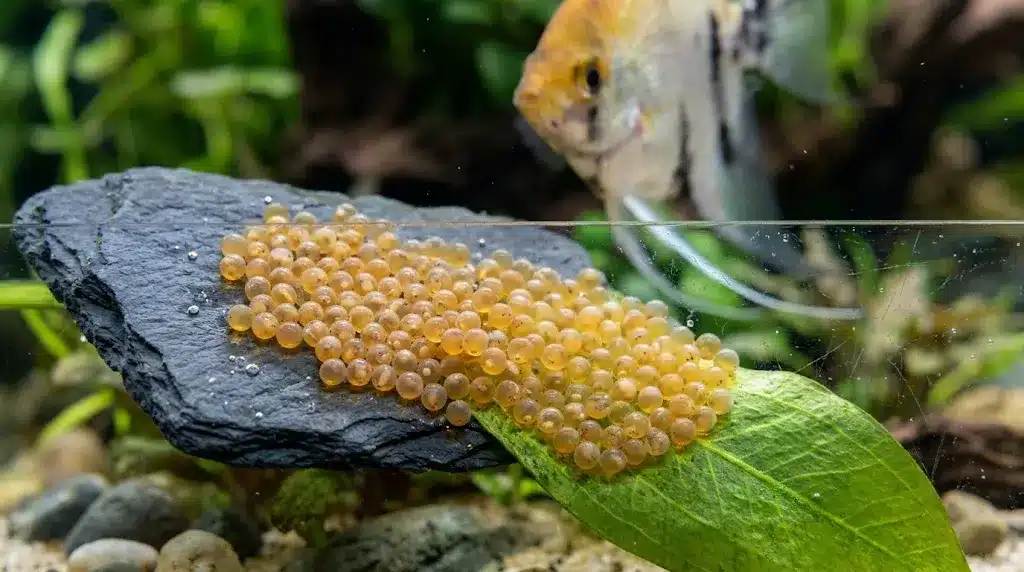
If you are trying to identify and care for angelfish egg clusters, look for these signs:
- Fertilized eggs: Usually clear, translucent, or light amber, with a darker embryo developing inside.
- Infertile eggs: Often turn opaque white within the first day.
- Dead eggs: Become solid white and may develop fuzzy fungus.
- Healthy clutch: Parents fan the eggs and remove dead or unfertilized ones.
If you want angel fish eggs pictures for comparison, take photos from the same angle each day. A photo record makes it much easier to see whether the eggs are developing, turning white, or growing fungus.
Angelfish Eggs Hatching Timeline: (Day-by-Day)
This timeline assumes a stable temperature around 78–82°F and good water quality. Your fish may vary by a day, especially if the water is cooler.
| Time after spawning | What you will see | What to do |
|---|---|---|
| Day 0 | The female begins to lay eggs in rows; the male follows to fertilize them. | Keep the tank calm and avoid sudden changes. |
| First 12–24 hours | Fertile eggs remain translucent; infertile eggs may start turning white. | Observe without disturbing the parents. |
| Day 1–2 | Embryos become visible; tiny eyes and movement may appear. | Maintain stable temperature and clean water. |
| Day 2–3 | Most viable eggs hatch into wrigglers. | Do not feed yet; the free swimming fry still use their yolk sac. |
| Day 3–5 | Wrigglers stay attached or rest near the spawning site while absorbing yolk. | Prepare baby brine shrimp or another suitable first food. |
| Day 5–7 | Fry become free-swimming and begin searching for food. | Start very small, frequent feedings. |
At 80°F, many breeders see hatching at about 60 hours, followed by roughly five days in the wiggler stage. Other reliable sources place hatching at 36–48 hours, which shows why temperature and individual pairs matter.
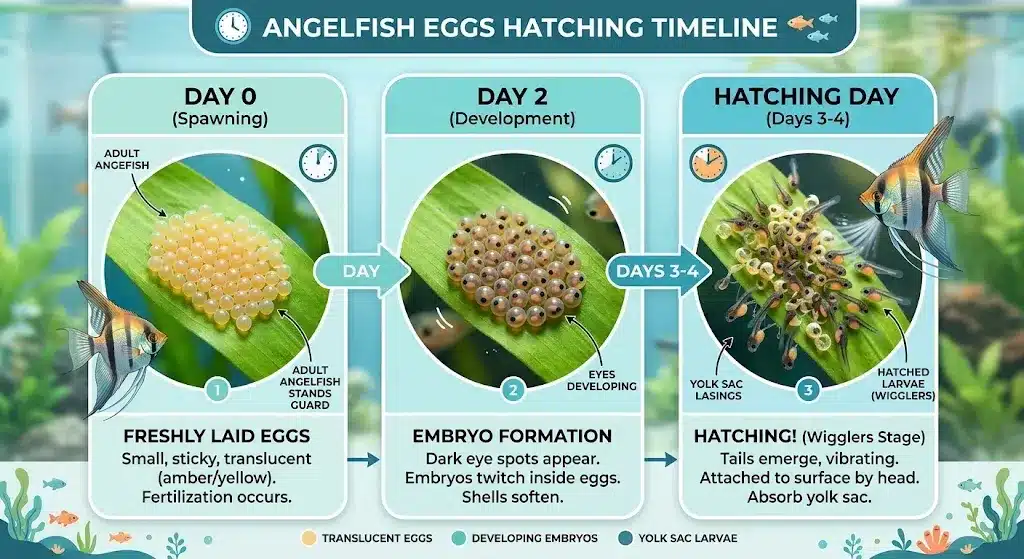
The Different Stages of Angelfish Egg Development
The stages of angelfish eggs follow a predictable pattern: spawning, fertilization, embryo development, hatching, wiggler stage, and free-swimming fry.
Stage 1: Spawning and fertilization
The female lays adhesive eggs on a clean vertical or broad surface. The male follows behind her and releases milt to fertilize the eggs. Angelfish are cichlids, and both parents may participate in guarding the spawn.
Stage 2: Embryo development
During the first 24 to 48 hours, fertile eggs remain translucent while the embryo darkens and develops. You may see a small dark spot, then movement inside the egg.
Stage 3: Hatching
The eggs hatch into tiny larvae. They may still look like eggs at first, but their tails begin to move and they eventually wriggle free of the eggshell.
Stage 4: Wiggler stage
Newly hatched fry are called wigglers or wrigglers. They hang from the spawning surface by a sticky thread or rest nearby while they absorb their yolk sac. They do not need food during this stage.
Stage 5: Free-swimming fry
Once the yolk sac is mostly gone, the fry become free swimming. This is the point when they need appropriately sized food, usually newly hatched brine shrimp nauplii or a fine commercial fry food.
What Happens When Angelfish Eggs Hatch?
When freshwater angelfish eggs hatch, the fry emerge with a visible yolk sac attached to their bodies. They cannot swim well yet, so they cluster together and wriggle in place.
Parent fish often move the wigglers to a safer spot, sometimes a shallow pit in the substrate. They may pick up stray fry in their mouths and return them to the group.
Do not feed immediately after hatching. The fry rely on their yolk sac for several days, and adding food too early only fouls the water.
Why Are Angelfish Eggs Turning White or Fungus-Covered?
White eggs usually mean the egg was infertile, died, or became infected. Fungus often appears as a fuzzy white coating, especially on eggs that were not fertilized or were already dead.
Common causes include:
- The male did not fertilize the eggs.
- The pair is young or inexperienced.
- Water quality dropped.
- The eggs were not fanned or aerated properly.
- Dead eggs were left in the clutch and fungus spread.
Remove dead eggs with a pipette if you can do it without disturbing the healthy clutch. In an artificial hatching jar, many breeders use methylene blue at a safe labeled dose to slow fungus, while keeping a gentle airstone nearby for oxygen-rich water movement.
Do Angelfish Parents Protect Their Eggs and Fry?
Yes. Angelfish parents often guard the eggs, fan them with their fins, remove dead eggs, and defend the area from other fish. This behavior improves oxygen flow around the clutch and helps prevent fungus.
However, not every pair makes good parents. A first spawn can end badly because the fish are nervous, inexperienced, or disturbed by tankmates. Some pairs eat the eggs; others abandon them.
If you want to try parent-raising, keep the breeding pair in a quiet aquarium without other fish. Feed them well, avoid sudden movements, and give them a stable environment. Even then, some pairs never reliably raise fry.
How to Care for Angelfish Eggs Before Hatching
Good angelfish egg care starts before the fish lay eggs. A clean, stable breeding aquarium gives the pair the best chance of producing viable fry.
Set up the right tank
A 20-gallon high tank is a practical minimum for a breeding pair, though a larger tank gives them more security. Angelfish prefer tall aquariums because adults can grow large and tall-finned.
Use a mature sponge filter rather than a strong power filter. A sponge filter provides biological filtration without creating a current strong enough to disturb eggs or fry.
Keep the water stable
Keep the water temperature steady, ideally around 78–82°F. Avoid large pH swings and do not chase perfect numbers with chemicals. Stable, clean water matters more than forcing an exact pH.
If your tap water is extremely hard, reverse osmosis water, often called R.O. water, can help some breeders. Do not make sudden changes; blend or adjust water gradually if needed.
Protect the spawn
If the eggs are in a 55 gallon community tank or another community tank, other fish may eat them. In that case, you may need to remove the eggs to a separate hatching container or move the parents to a dedicated aquarium for breeding angelfish.
A simple hatching jar can work well. Use a clean large jar or small tank, mature tank water, gentle aeration, and a stable heater if necessary. Keep a gentle stream of bubbles near the eggs so oxygenated water moves across them.
How to Care for Newly Hatched Angelfish Fry
Newly hatched angelfish fry need clean water, gentle aeration, and correctly sized food once they become free-swimming. They are fragile, so avoid strong currents, overcrowding, and sudden water changes.
Feeding angelfish fry
Start feeding when the fry become free-swimming, usually around five to seven days after hatching. Newly hatched baby brine shrimp is the classic first food because the nauplii are small, nutritious, and easy for fry to hunt.
You can also use:
- Microworms
- Vinegar eels
- Hikari First Bites or another fine fry food
- Commercial liquid fry food, used carefully to avoid fouling the water
Feed tiny amounts several times a day. Remove uneaten food quickly, because leftover food damages water quality fast in a small nursery tank.
Water changes for fry
Frequent water changes are essential once the fry are feeding. In a smaller aquarium, small daily changes using aged, temperature-matched tank water help keep ammonia and waste under control.
Do not use soap or clean the sponge filter with untreated tap water. Rinse sponge media in removed aquarium water instead, so you do not kill beneficial bacteria. angelsplus
Common Angelfish Hatching Problems and How to Prevent Them
Most hatching problems come down to fertility, fungus, water quality, or parental behavior. Knowing which problem you have helps you respond correctly.
| Problem | Likely cause | Practical response |
|---|---|---|
| All eggs turn white | Infertile eggs or an inexperienced male | Wait through one spawn; improve conditioning and try again. |
| Fuzzy white growth | Fungus on dead or unfertilized eggs | Remove dead eggs; use methylene blue only as directed in an artificial setup. |
| Parents eat eggs | Stress, inexperience, or disturbance | Move the pair to a quiet breeding tank or remove the eggs for artificial hatching. |
| Low hatch rate | Poor fertilization, unstable water, or hard-water issues | Improve stability, aeration, and cleanliness before changing chemistry. |
| Fry die after hatching | Poor water quality, bacteria, or inadequate first food | Use small frequent water changes and offer newly hatched brine shrimp or fine fry food. |
If the eggs never hatch, the pair may have a fertility problem, or a young male may not yet fertilize the spawn reliably. This often improves as the fish mature.
Should You Remove Angelfish Eggs?
Remove the eggs if the parents are eating them, the spawn is in a community tank, or you want the highest control over hatching. Leave them with the parents if the pair is attentive and you want to watch natural parental care.
Artificial hatching gives you more control. Move the spawning slate or leaf into a prepared hatching jar, keep the eggs submerged, provide gentle aeration, and maintain stable warmth. Many breeders use methylene blue and remove dead eggs daily.
Parent-raising is less work once a pair learns the job, but it can take several spawns before a pair consistently raises fry.
Angelfish Life Cycle: From Egg to Adult
The life cycle of angelfish moves from egg to wiggler, free-swimming fry, juvenile, and adult. The fastest changes happen in the first week, but raising angelfish to a sturdy juvenile size takes weeks of consistent feeding and clean water.
A practical angelfish life cycle looks like this:
- Egg: Laid and fertilized on a flat surface.
- Embryo: Develops inside the egg for about two to three days.
- Wiggler: Hatches and lives off the yolk sac.
- Free-swimming fry: Begins feeding on tiny live or prepared food.
- Juvenile: Grows quickly with frequent feeding and water changes.
- Adult: May form a pair and eventually spawn.
Healthy angelfish grow best when they are not overcrowded. A larger tank, frequent partial water changes, and small frequent meals support better growth and reduce stunting.
FAQs
How to care for angel fish eggs?
Keep the water warm, clean, and stable. Leave the eggs with attentive parents, or move them to a hatching jar with gentle aeration. Remove white or fuzzy dead eggs carefully, and do not feed until the fry become free-swimming.
What to do when angel fish lay eggs?
First, identify the spawning surface and avoid sudden tank changes. If the parents are guarding the eggs, leave them alone. If the eggs are in a community tank or the parents are eating them, prepare a separate hatching container.
How to raise angelfish eggs?
You can raise them with the parents or artificially. For artificial rearing, use a clean hatching jar or small tank, mature tank water, gentle aeration, stable heat, and daily removal of dead eggs. Once fry become free-swimming, feed newly hatched brine shrimp or an appropriate fine fry food.
How to hatch angelfish eggs?
Keep the eggs at a stable warm temperature, provide oxygenated water movement, and prevent fungus. If using a hatching jar, position the airstone so a gentle stream of bubbles moves water over the eggs without blasting them.
How long for angelfish eggs to hatch?
Most freshwater angelfish eggs hatch in about 48 to 72 hours after spawning. At 80°F, many hatch around 48 to 60 hours.extension.
What do fertilized angelfish eggs look like?
Fertilized angelfish eggs usually look translucent, pale amber, or slightly darker as the embryo develops. Infertile eggs tend to turn opaque white.
Do angelfish lay eggs without a male?
A female can lay eggs without a male, but those eggs will not be fertilized. They will usually turn white and develop fungus.
Can angelfish eggs hatch in a community tank?
They can, but survival is much lower because other fish may eat the eggs or fry. A separate breeding aquarium or hatching container gives the spawn a better chance.
What is the survival rate of angelfish eggs?
There is no fixed survival rate. Under good conditions, hatching may reach 60–100%, but many fry die before adulthood; beginner-raised broods often lose most fry to water-quality or feeding problems.
How do you hatch angelfish eggs without the parents?
Move the egg-covered slate or leaf to a hatching jar with matching tank water, 78–82°F heat, and gentle airstone flow. Add methylene blue if needed, remove white eggs, and feed only once fry swim freely.
Conclusion
Angelfish eggs hatching is one of the most exciting parts of fishkeeping, but success comes from preparation rather than luck. Keep the water warm and stable, protect the spawn from tankmates, and decide early whether the parents or an artificial hatching jar will raise the fry. Most viable eggs hatch within about two to three days, then spend several more days as wrigglers before becoming free-swimming.
Once the fry begin swimming, your job changes quickly. Feed newly hatched baby brine shrimp or a suitable fine fry food in small amounts, remove uneaten food, and perform gentle frequent water changes. A sponge filter, stable temperature, and clean nursery tank give baby angelfish the best start.
If your first spawn fails, do not give up. Many angelfish pairs need practice before they become reliable parents. With patience, clean water, and the right first foods, you can turn a cluster of tiny eggs into a thriving group of juvenile angelfish.
Recommended posts
- Angelfish Egg Stages & Hatching Process: (Exclusive Guide)
- The Complete Guide to Angel fish Tank Setup and Breeding Tips
- Breeding Angelfish – A Complete Guide for Beginners
- Angelfish Eggs Turning White? Common Reasons & Prevention
- Angelfish Fry Growth Stages: From Egg to Juvenile