Angelfish in the wild are freshwater cichlids of the genus Pterophyllum, native to the warm, slow-moving rivers, floodplains, lagoons, and flooded forests of the Amazon Basin, Orinoco Basin, and Guiana Shield in South America.
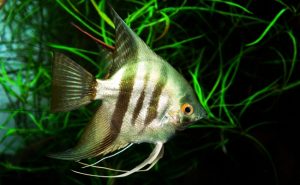
Their tall, flattened bodies, long fins, dark vertical bars, and calm ambush-hunting behavior are adaptations that let them move easily through submerged roots, branches, plants, and tannin-stained water while avoiding predators.
In this guide, you will learn exactly where freshwater angelfish naturally live, what they eat in the wild, which wild Pterophyllum species exist, and how seasonal flooding shapes their habitat. You will also discover how wild angelfish behave, how they breed and protect their young, and why their natural adaptations matter for responsible aquarium care.
Where Do Angelfish Naturally Live?
Freshwater species naturally live in tropical South America, with the genus centered on the Amazon Basin, the Orinoco Basin, and river systems of the Guiana Shield.
The most familiar species, Pterophyllum scalare, occurs across a broad Amazonian range that includes parts of Brazil, Peru, Colombia, and neighboring countries; other Pterophyllum species occupy more specialized portions of this wider region.
They are not fish of powerful main-river currents. The wild type of angel fish favor slow or still water: quiet stream margins, oxbow lakes, lagoons, backwaters, swampy floodplains, and flooded forest edges. In these places, submerged roots, fallen timber, floating vegetation, and tall aquatic plants create the sheltered, three-dimensional environment they need.
A useful way to picture their habitat is to imagine the Amazon during the wet season. Rising water spills across the forest floor, turning trees, shrubs, roots, and leaf litter into an enormous underwater nursery.
They move into these flooded margins, where the water slows, food becomes abundant, and vertical structure gives them cover from larger predators. This is why their tall, flattened bodies make sense: they are built to slip between stems and roots rather than fight current in open water.
Water conditions vary by location, but wild angelfish generally inhabit warm, soft, acidic to near-neutral water. Published species profiles commonly place P. scalare around 24–30°C, with pH values roughly between 5.5 and 7.4, while P. leopoldi is associated with softer, more acidic conditions, often below pH 7. Blackwater habitats can be especially low in minerals and stained brown by tannins released from leaves, wood, and decomposing plant material.
Step-by-Step Example: Finding Wild Angelfish Habitat
A practical way to understand where angelfish live is to follow the water through one Amazonian flood cycle:
- Start in the main river channel. During low water, the river may run relatively fast and carry sediment. Angelfish usually avoid these exposed, current-heavy zones because they offer little cover and make precise maneuvering difficult.
- Move toward a tributary or backwater. As the channel narrows, current weakens. Fallen branches, overhanging vegetation, and submerged root tangles appear along the banks.
- Enter the flooded forest margin. When seasonal rains raise the water level, fish gain access to root systems, submerged shrubs, and leaf litter. A fish use these areas for feeding, shelter, and breeding.
- Look for structure, not just plants. A wild angelfish habitat does not need to look like a dense planted tank. It may contain sparse vegetation but abundant vertical cover: tree roots, branches, palm fronds, submerged wood, and floating plants.
- Check the light and water movement. Wild angelfish often occupy shaded or dimly lit zones where dark vertical bars help break up their outline among stems and shadows.
- Observe the food web. Insects, larvae, small crustaceans, and fish fry gather in these sheltered margins. That prey base supports the angelfish’s carnivorous-leaning omnivorous diet.
The key point is that Angelfish Habitat is defined less by a particular river name and more by a repeatable pattern: warm, slow, structured water with plenty of vertical cover. A fast, bare riverbank may be nearby, but it is not where wild angelfish usually thrive.
What Freshwater Angelfish Species Are Found in the Wild?
Three recognized freshwater species occur in the wild: Pterophyllum scalare, Pterophyllum altum, and Pterophyllum leopoldi. All are South American cichlids, but they differ in size, range, habitat preference, and body proportions.
Pterophyllum scalare
Pterophyllum scalare is the species most people mean when they say “angel fish.” It has the widest natural distribution of the three and is the ancestor of nearly all common aquarium color and fin varieties, including silver, zebra, marble, koi, gold, platinum, veil, and albino forms.
In the wild, it occupies lake margins, sluggish streams, and vegetated or debris-filled areas. Field-oriented species accounts describe it among fallen branches, leaf litter, floating meadows, and submerged plants—habitats that provide both food and protection.
Pterophyllum altum
Pterophyllum altum, the altum species, is the giant of the genus. It is associated with the upper Orinoco system and nearby blackwater or clearwater habitats, where complex river margins provide shelter and hunting opportunities.
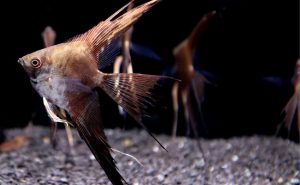
Altums are especially striking because their bodies are extremely tall and laterally compressed. That shape is not merely decorative: it helps them move through narrow gaps among roots, stems, and submerged wood.
Pterophyllum leopoldi
Pterophyllum leopoldi is smaller and less frequently seen in the aquarium trade. It is recorded from the Solimões-Amazon corridor between Manacapuru and Santarém in Brazil, as well as the Rupununi River and Essequibo Basin in Guyana.
This species favors slow-moving water and avoids fast currents. It shelters beneath root overhangs, submerged branches, and floating vegetation, often in soft, acidic water.
Wild Angelfish Versus Aquarium Varieties
A crucial distinction: most pet-store angelfish are not separate wild species. They are selectively bred forms of Pterophyllum scalare. A “koi angelfish,” “platinum angelfish,” or “veil angelfish” describes appearance, not a distinct species.
Wild-type angelfish usually show silver bodies with dark vertical bars. Those bars are functional camouflage, helping the fish blend into plant stems, root shadows, and dappled light. Generations of captive breeding have changed color, fin length, and pattern, but the underlying wild fish remains an Amazonian cichlid adapted to structured, slow water.
What Is the Natural Habitat of Wild Angelfish?
The natural habitat of wild fish is structured, sheltered, and seasonally dynamic. They live where water moves slowly enough for precise swimming and where roots, branches, plants, and leaf litter create places to hide, hunt, spawn, and raise young.
Vertical Structure Matters Most
They are not open-water swimmers by design. Their tall, thin bodies and long fins allow them to navigate vertically oriented cover: plant stems, tree roots, submerged branches, and the edges of floating vegetation.
This is one of the most important but underappreciated points about Angelfish Habitat. Many aquarium guides emphasize plants, but wild angels do not require a jungle of aquatic plants. They require structure. A root tangle beneath a fallen tree can be just as valuable as a dense bed of stems.
Shade, Tannins, and Low-Visibility Water
Many wild angelfish habitats are shaded by forest canopy or floating plants. Leaves and wood release tannins, giving blackwater systems an amber or tea-colored appearance. These tannins do not simply make the water look natural; they contribute to low visibility, which can reduce predator risk and help ambush-oriented fish hunt effectively.
Wild angelfish also use their own markings in this environment. Vertical bars break up the fish’s outline against stems and shadows, while the flattened body reduces the visible profile when viewed head-on.
Seasonal Flooding Creates Feeding and Breeding Grounds
The Amazon and Orinoco systems experience major seasonal water-level changes. During high-water periods, forests and floodplains become submerged habitat. Fish spread into these areas to feed and reproduce; during falling water, they retreat toward permanent channels, lagoons, and remaining cover.
This seasonal rhythm explains why they are so strongly associated with flooded vegetation. The floodplain is not just a backdrop—it is a temporary extension of their territory, hunting ground, and nursery.
What Do Angelfish Eat in the Wild?
Wild angelfish eat a protein-rich, opportunistic diet made up mostly of small animal prey: insects, insect larvae, worms, crustaceans, small fish, fish fry, and fish eggs. They also consume some algae and plant-associated material while foraging among vegetation and submerged surfaces.
They are best described as omnivores with a strong carnivorous tendency. Their diet reflects their habitat: slow, sheltered water contains abundant invertebrate life, while roots and plants provide hunting cover.
Typical Wild Foods
- Aquatic insect larvae
- Small worms and other benthic invertebrates
- Tiny crustaceans
- Small fish and fry
- Fish eggs when available
- Algae and plant material picked up incidentally or deliberately
How Wild Angelfish Hunt?
Angelfish are commonly described as ambush predators. Rather than chasing prey across open water, they wait near cover, watch for movement, then make a short, precise strike. Their body shape supports this strategy: a laterally compressed fish can hold position among stems, pivot quickly, and dart through narrow spaces.
This behavior explains why wild angelfish do not need to be constant open-water hunters. They conserve energy by using cover, patience, and sudden bursts of speed. In an aquarium, this translates into a fish that often hovers near plants or décor, watches its surroundings, and reacts quickly to small moving foods.
Diet Changes with Habitat and Season
During flooded periods, more territory and more prey become available. Invertebrates colonize submerged leaves and wood, while small fish use the same sheltered margins. Angelfish can take advantage of this seasonal abundance.
When water levels drop, fish concentrate into remaining pools, channels, and vegetated margins. Food may become more localized, making efficient foraging and territorial awareness more important. This seasonal pressure helps explain the angelfish’s adaptable feeding behavior.
How Do Wild Angelfish Behave?
Wild angelfish behave as alert, territorial cichlids with a strong social and parental side. They may move in loose groups when young or outside breeding season, form bonded pairs for reproduction, and defend spawning sites aggressively when eggs or fry are present.
Shoaling, Pairing, and Territory
Juvenile and non-breeding angelfish may associate in loose groups. This behavior likely improves predator awareness: many eyes detect danger sooner than one. As fish mature, pairs often form, particularly around breeding conditions.
Once a pair forms, behavior changes. The pair selects and cleans a spawning surface, defends nearby space, and drives away fish that could eat eggs or fry. This territorial behavior is normal cichlid behavior, not random aggression.
Breeding and Parental Care
Wild angelfish usually lay eggs on vertical or near-vertical surfaces: broad leaves, submerged wood, roots, or other firm structures. Both parents participate in guarding and caring for the brood. They fan the eggs, remove unfertilized or damaged eggs, and protect newly hatched fry.
A successful spawn can produce hundreds of eggs, though not every egg survives in nature. Predation, water conditions, fungus, and inexperience all reduce the number of fry that reach adulthood. This high reproductive output makes sense in a habitat where young fish face many predators.
Predator Avoidance
Wild angelfish rely on camouflage, cover, and quick maneuvers. Their vertical stripes disrupt their outline among plant stems and roots. Their tall, narrow bodies let them disappear into vegetation rather than flee across open water.
They also use position. A wild angelfish often stays near an escape route: a root mass, branch tangle, or dense plant margin. When threatened, it can slip backward into cover instead of making a long, exposed swim.
Communication and Aggression
Angelfish communicate through posture, fin position, chasing, and brief displays. During breeding, aggression becomes more focused and intense because the pair is protecting a valuable resource: eggs and fry. Outside spawning, many angelfish are comparatively peaceful for cichlids, though individuals still establish personal space.
Angelfish Adaptations for Life in the Wild:
Wild angelfish adaptations are practical solutions to life in slow, structured South American waterways. Their appearance is not accidental; nearly every major trait helps them survive among roots, stems, shadows, and seasonal floods.
Laterally Compressed Body
The angelfish’s thin, disc-like body lets it move through narrow gaps between plants, roots, and branches. It also reduces the fish’s visible profile when a predator approaches from the front.
Long Fins and Tall Dorsal/Anal Fins
Long fins improve maneuverability at low speeds. Instead of relying on fast, sustained swimming, angelfish can hover, turn tightly, and make short bursts through complex cover.
Vertical Bar Camouflage
Dark vertical bars break up the body outline. Among vertical stems, shadows, and root systems, this pattern makes the fish harder to detect. It is one of the clearest examples of form matching habitat.
Ambush Feeding Strategy
Angelfish do not need a streamlined, torpedo-shaped body because they are not built for long pursuits. Their hunting strategy depends on patience, concealment, and a rapid strike from cover.
Biparental Breeding
Both parents guard eggs and fry. In a habitat full of egg predators, shared parental care increases the chance that offspring survive long enough to become free-swimming.
What Aquarium Keepers Can Learn From Wild Angelfish
Understanding freshwater angelfish in the wild improves aquarium care. The goal is not to recreate the Amazon exactly, but to provide the environmental cues that matter to the fish.
- Provide height and structure. Angelfish are tall fish that use vertical cover, so tank height, tall plants, driftwood, and broad leaves matter.
- Keep water warm and stable. Wild habitats are tropical; stable warmth supports immune function, digestion, and breeding behavior.
- Use gentle flow. Angelfish are adapted to slow water, not strong current. Position filter output to avoid constant battling against flow.
- Offer cover and sight breaks. Plants, wood, and leaf litter reduce stress and give fish a place to retreat.
- Feed varied animal-based foods. In the wild, angel fish eat invertebrates and small prey, so a varied diet better matches their natural feeding pattern than one staple food alone.
- Respect breeding behavior. A bonded pair may become territorial. This is natural, especially when eggs or fry are present.
- Never release aquarium fish. Captive angelfish varieties are domesticated line-bred fish and should never be released into local waterways.
Key Questions About Freshwater and Marine Angel fish in the Wild
Where do angelfish naturally live?
They naturally live in slow-moving rivers, floodplains, lagoons, backwaters, and flooded forest margins across the Amazon Basin, Orinoco Basin, and Guiana Shield regions of South America.
What do angelfish eat in the wild?
They eat insects, larvae, live baby brine shrimp, worms, small crustaceans, fish fry, fish eggs, and some algae or plant material. Their diet is omnivorous but leans heavily toward animal protein.
What fish naturally cohabitate with angelfish in the wild?
In the wild, freshwater angelfish naturally live in South America Amazon Basin waters with cardinal tetras, Corydoras catfish, dwarf cichlids, and other small fish. However, natural tank mates vary by habitat. Larger fish may prey on angelfish, while smaller fish can become food as angelfish mature.
What freshwater angelfish species are found in the wild?
Three species are recognized: Pterophyllum scalare, Pterophyllum altum, and Pterophyllum leopoldi.
What is the natural habitat of wild angelfish?
Their habitat is warm, slow, structured freshwater with roots, branches, aquatic plants, floating vegetation, and often tannin-stained water.
How do wild angelfish behave?
They forage near cover, may form loose groups, pair up for breeding, defend spawning territories, and provide biparental care for eggs and fry.
Are wild angelfish aggressive?
They can be territorial, especially while breeding, but they are generally less relentlessly aggressive than many other cichlids. Their aggression is usually contextual and linked to spawning or defense of young.
Are angelfish in the wild the same as pet-store angelfish?
The common pet-store angelfish is usually Pterophyllum scalare, but most color varieties are selectively bred. Wild-type fish generally show the silver body and dark vertical bars that inspired many aquarium strains.
Do angelfish live in the Amazon River itself?
They are associated with the Amazon Basin, but they usually occupy slower margins, tributaries, floodplain lakes, and backwaters rather than fast main-channel currents.
Do wild angelfish eat plants?
They may consume some algae and plant material, but animal prey makes up the core of their diet. They are omnivores with a strong preference for invertebrates and small aquatic animals.
Are angel-fish endangered in the wild?
Pterophyllum scalare is widely distributed across the Amazon Basin and is not generally treated as a major conservation concern in the sources reviewed here. Habitat protection still matters because Amazonian freshwater systems face broader environmental pressures.
Conclusion
Angel fish in the wild are far more than graceful aquarium fish. They are specialized South American cichlids shaped by slow-moving rivers, seasonal floods, tannin-stained water, and the dense vertical cover of roots, branches, and flooded forests. Their tall bodies, dark vertical bars, long fins, ambush-hunting style, and devoted parental care all reflect the demands of life in the Amazon and Orinoco basins.
Understanding Angelfish Habitat changes how you see the species. A wild angelfish is not simply a “community fish” that happens to look elegant; it is a habitat specialist that relies on shelter, calm water, varied prey, and secure breeding surfaces. The three-wild species—Pterophyllum scalare, Pterophyllum altum, and Pterophyllum leopoldi—show how different river systems and water conditions produce different adaptations.
For aquarium keepers, the lesson is practical: provide height, structure, gentle flow, stable warm water, and varied protein-rich foods. For nature lovers, the lesson is broader: protecting flooded forests, clean tributaries, and connected floodplains protects the entire ecosystem that makes wild angel fish possible. When you understand where freshwater angelfish naturally live and how they behave, you can appreciate not only their beauty, but the remarkable wild world that created it.